Wageningen, 2 November 2009. During the CTA ICT Observatory 2009 we interviewed Mike Davies from Esoko, in Ghana. Esoko is a software platform licensed to facilitate the flow of market information between farmers, governments, researchers and other stakeholders involved in agriculture and rural development. It is used to share information on prices, offers, price of fertilizers etc. It is managed by the web, but delivered via mobile phones. Mark underlines the potential positive effects that Market Information Services such as Esoko can bring about, both in agriculture as well as in for other sectors. He then concludes talking about the difficulties he has encountered in this initiative, such as the lack of content available and the lack of right capacities to build and develop such software.
This Monday, 29 June 2009 turned out to be a rather momentous day for anyone interested in ICTs for development in general, and mobile content-driven information services, in particular. The Grameen Foundation announced the launch of its AppLab in Uganda, realised in collaboration with the Internet search and services giant Google and the African mobile operator giant MTN.
The press release gives details of the 5 SMS-based mobile applications launched by the project. The initiative is introduced in detail at the Official Google Africa blogby Rachel Payne, Country Manager, Uganda. The services fall with 3 silos:
Farmer’s Friend, a searchable database with both agricultural advice and targeted weather forecasts
Health Tips which provides sexual and reproductive health information (family planning, maternal & child health, HIV/AIDS, STI/STDs, sexuality)
Clinic Finder, which helps locate nearby health clinics, their services and telephone numbers
Google SMS Search, an SMS-based mobile serach engine more consistent with Google’s original role.
Google SMS Trader, which matches buyers and sellers of agricultural produce and commodities as well as other products. The services are SMS-based and designed to work with basic mobile phones to reach the broadest possible audience.
Needless to say, I have been very excited by the news about these new services. So, I took a couple of days to process and digest it. The news has caused quite a storm in the ICT4D community. The White African comments on the participation in this intiative of prominent stakeholders:
Beyond the applications themselves, what I find most compelling is how the Grameen Foundation collected such a high-powered group of partners. The list reads like a who’s-who of innovative mobile services and development in Africa with Google, MTN Uganda, Technoserve, Kiwanja.net, and BRODSI to name a few. It’s a mixture of for-profit businesses, local NGOs and non-profit tech organizations.
I agree that this is a significant observation. It is well recognised that the implementation of successful mobile services involves the syndication of mobile operators (in this case MTN) and content providers (read Google). But the success of mobile services implemented in Africa, largely depends on their the existence of a support network on the ground. The role the project of the Grameen Foundation, its Technology Centre in Uganda and their network of Village Phone Operators (VPOs) increase the potential for adoption of the new services.
Ken Banks explains how the Google SMS Tips service was tried through an AppLab/MTN “call centre” where quieries from the users were received and short answers of maximum 160 characters were formulated. He brings up issues related to the process of development of IT services such as information behaviour* in developing countries, proximal literacy, HCI and prototyping. With regards to Google SMS Trader, which as a mobile commerce platform is of my primary interest to me, Ken Banks that a “whole suite of technologies on which to base solutions, including J2ME, WAP, high-end smart phones, 3G and MMS” were considered during the development process and SMS was eventually chosen. Still, I think that the involvement of Google in services such as Farmer’s Friend and Trader opens up another frontline in the rivalry between Android and Symbian. The services provided by Google SMS Tips in Uganda are consistent with those introduced by Nokia Tools in India. The respective uptake and popularity of these services might hold the key to the eventual spit of the premium mobile contant market in the developing world between Android and Symbian.
* Information behaviour meaning, “the totality of human behaviour in relation to sources and channels of information, including both active and passive information seeking and information use”, definition by Wilson 2000.
A story found at the Liberian. Written by Oona Burke, guest columnist; published on 19 June, 2009.
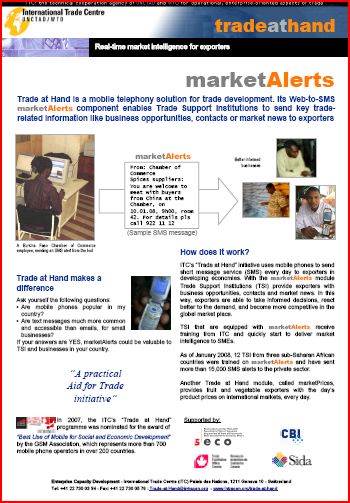
The Ministry of Commerce and Industry in collaboration with Geneva based NGO, International Trade Center has recently completed the test phase of “Trade At Hand”, a cell phone based system that helps connect market women to more competitive prices for the goods they buy. The cell phone based system works similarly to posting goods for sale in a newspaper advertisement or online (Craigslist, etc). Farmers around Liberia are able to advertise their goods for sale (for example, pepper) and market women on the system are then able to check their phones for all the advertisements of pepper for sale from farmers around the country that day. On the system, market women have access to offers organized by products, and are able to exchange reciprocal offers and match each other’s demands for the sale and purchase of goods.
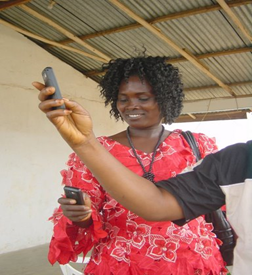
A market woman and farmer work on Trade at Hand
Thus far the test group includes the training of 50 market women across several Monrovia based markets, and 50 farmers in various counties. Market women on the project are extremely excited about the system and are anxious to expand the number of products available to buy.
Currently the system includes pepper, okra, bitter ball, cassava, plantain, greens, palm oil /nut, and several others. With some market women on the system reporting that they usually spend as much as $35 a month on scratch cards to communicate with sellers of goods, Trade at Hand, allows market women to also reduce their communication costs by viewing a larger number of offers on their telephones, for a price lower than the cost of one telephone call.
Two market women show their excitement in practicing using the system at Ma Kebbeh compound, Red Light Market
Trade at Hand enables market women to carry out their business in a way that increases their chances of accessing better quality and better priced produce. In turn, farmers are also enabled to better off-load their produce, and minimize produce wastage. The system also helps market women develop their price intelligence, because they have access to a variety of prices for the same products.
Once the system is tested with the pilot group of market women and farmers, it is hoped that the system can be made available to a larger number of market women and farmers.
Trade at Hand is similar to Cell Bazaar, a telephone based buying and selling system in Bangladesh, that currently has 20 million users.
I came across an interview, prepared by Ms. Katrine Veclas from MobileActive, with Mr. Jonathan Jackson of Dimagi. The interview introduces the Rapid Android technology which offers an innovative way of configuring the back-end of SMS deployments.
Mr. Jonathan Jackson, summarises the currently available deployment options as including deployments via international SMS gateways and localised deployments. Under the first option the deployment path consists of: 1) clients sending SMS to an international phone number 2) messages are transferred to an international SMS gateway 3) message go through the Internet to a Web server 4) client machines are able to access the Web server through the Internet to view the data.
This deployment option is great for large scale applications. In the area of dissemination and collection of mobile market information, I am aware of ITC’s Trade at Hand using similar deployment paths for the delivery of Market Alerts from trade support institutions to networks of exporters, and for the collection and analysis of local market information under the mCollect project.
The second deployment option mentioned by Mr. Jonathan Jackson includes 1) local server connected to a phone, being able to talk to local clients and 2) client machines hitting the local server directly, or through the Internet. Small deployments are viable under this option. But deployments are subject to the hazards of thier small scale. Even small problems with the systems can become critical because they require specialised engineering skills. Such deployments are at risk of losing users’ interest when qualified support is not available on the ground. A market oriented project which might fall under this category is the Cambodia Crop Production and Marketing Project (CCPMP).
Vodpod videos no longer available.
The Rapid Android technology presented my Mr. Jonathan Jackson allows for the use of Android phones not only as SMS clients, but also as back-end servers. This dual use greatly simplifies the equipment needs and the skill needs for the deployment of SMS solutions. It also allows for immediate analysis of incoming data in real time.
For the sector of mobile market information systems, Rapid Android presents enhanced SMS broadcasting and data collection opportunities. With the future developments of Rapid Android outlined by Mr. Jonathan Jackson under wasy, Rapid Android presents the opportunity to develop more resilient and extensive market infromation collection networks. Even though the benefits of broadcasting up-to-date market informatiton to farmers in remote areas have been widely recognised. I think more efforts are needed to improve the market information generation process and to ensure the quality of the information. So far the accuracy of the collected information is largely due to the skills and experience of market ennumerators based out in the field. The transformation, analysis and response to this information is tends to be removed at central head offices and headquarters. With the availability of technologies similar to Rapid Android, the opportunity of relocating the analysis closer to the source of the data opens up.
News regarding current work on the implementation of a market information systems in Ethiopia, released by Wageningen University and Research Centre (Wagenigen UR – LEI) on 24 Feb 2009.
From 24 to 31 January, Olga van der Valk and Monika Sopov (Wageningen International) visited Ziway and Meki, two villages in the Rift Valley south of Addis Ababa, Ethiopia. Their goal was to develop a Market Information System (MIS) for small-scale outgrowers of green beans, whose production is contracted by an exporter to Europe. The design of an MIS was requested by a project with CFC funding aiming at promoting small-scale growers’ participation in exports. In a workshop with local stakeholders, the findings of an earlier assessment on market information sources and communication lines were discussed.
An MIS is an instrument to reduce market insecurity by providing more transparency in the market. Other instruments are the implementation of (innovative) technology and horizontal and vertical market coordination to strengthen market position and to combat seasonality. To further define the MIS, stakeholders were asked to prioritise their demand for information: whether related to export or domestic markets; whether on daily-changing information such as prices and supply or on market-technical data for the development of marketing strategies.
Neither stakeholders nor farmers currently work with or have a view on long-term marketing strategies to develop the small-scale horticulture sector. This makes it difficult to prioritise the marketing information needed to design and operate an MIS. The proposal by the workshop stakeholders was to enter into dialogue with the Ethiopian government to improve its centralised MIS used for statistical purposes, and to make it more accessible to farmers. The recommendation by the Dutch experts was to set up a business service centre to collect available historical data, including surveys and statistical information, and use this information in the development of marketing planning skills among small-scale farmers and governmental officers. This will enable farmers to efficiently use and sustain the technology currently in development.
Here is a very informative educational documentary on Warehouse Receipt Systems produced by the Technical Centre for Agricultural and Rural Cooperation ACO-EU (CTA), Agence Français de Développementé (AFD) and the Natural Resources Institute (NRI).
The film documents a study visit to Tanzania and South Africa. Even though the film provides plenty of useful information, its authors make sure to note:
“The examples presented in these two countries are typified by particular experiments and contexts and cannot simply be transposed to other cases. Nonetheless there are a great number of lessons to be learnt and which could provide guidancefor certain aspects of orientation and initiatives in your respective countries.”
I personally think that the documentary illustrates theoretical issues which are encountered the world over, and are not specific to any particular context. The film raises questions regarding trust, confidence, contractual completeness, regulation, product quality and standardisation. Even though in this documentary the issues emerge with regards to warehouse receipt systems, they are intrinsic characteristics of any market negotiations (and eventual transactions) taking place without the double coincidence of time and place. The film focuses on futures markets i.e. transactions without coinsidence in time. Conversely, market negotiations carried out via mobile phones, or other ICTs exemplify transactions without coinsidene in place.
Warehouse receipt systems were developed in the 1990s as a response to farmers’ income instability due to price fluctuations resulting from liberalisation. Since prices tend to be low during harvest periods and to subsequently rise, warehouse reeipt systems provide a solution by storing commodities for the suration of the low price season. Price volatility and lack of quality standards are attributed to market liberalisation in the agricultural sector.
Warehouse receipt systems operationalise the food supply chain and involve the following stakehoders:
farmers (individuals or cooperatives)
warehouse operators
financial institutions
exporters, traders
Tanzania
The warehouse receipt system was introduced in Tanzania in 2005 with the pilot crops of coffee and cotton. It enables farmers to receive loans and assure the quality of their produce. The system allows coffee producers (individuals or cooperatives) to store their coffee in a silo. Upon the receipt of the coffee the producers are issued with 2 certificates: certificate of title for them to keep and certificate of pledge to provide to third parties. These are normally cooperative or commercial banks participating in the system. The certificates of deposit allow farmers to induce confidence in the financial institutions. They also enable the banks to reach a new set of customers for financial services.
The warehouses also ensure the transparency of the commodity marketing system. Commodities are classified according to quality and offered for sale at regional and sub-regional markets. For example, coffee is graded and offered for sale at auctions administered by a public organisation.
Producers in other sectors, such as the Chawampu rice growers cooperative, have followed suit. Representatives of the cooperative introduce a model whereby they are able to offer 70% of market value of deposited quantities of rice. Subsequently, after selling the crop and substracting the administrative costs the cooperative, they provide a second payment to the members of the cooperative. Farmers use any additional income in order to buy seeds, fertilizer and to develop off-season activities.
The warehouse receipt systems functions well due to the high price differentials between the post-harvest season and the hungry season. The main challenges to the warehouse receipt system remain:
providing adequate infrastructure
ensuring warehouse security
reinforcing producers’ organisations
increasing the number of quality control specialists
reducing operating costs
South Africa
South Africa presents an advanced example based on the warehouse weceipt system because it has a functioning futures market in agricultural commodities. The SAFEX was established in the 1990s during an intense period of market liberalisation.
The advantages of South Africa include its good financial infrastructure for the settlement of deals and the quality of its physical infrastructure enabling the trading, warehousing and transportation of the commodities. Critical is the legal enforcability of contractual rights and of legal receipt rights. Thereby, people are able to take the necessary steps and to manage their post-harvest risk well in advance.
SAGIS acts as an information intermediary for the South African commodity markets. It collects and distributes local consumption and up-to-date market information. The agricultural marketing giant SENWES provides mobile phone access to hourly prices of grain via SMS. Even though it is not typical of Africa in favouring large scale farmers, the South African warehouse receipt experience provides a useful benchmark for implementations elsewhere.
Here is a video I came across detailing the recent meeting of the CGIAR consortium for spatial information, under the heading “Mapping our future”, carried out on March 31- April 4 2009 in ILRI Nairobi, Kenya.
Video features interviews with Mr. Srikant Vasan from the Gates Foundation, Mr. Todd Slind from CH2M, Mr. Andrew Jarvis from Biodiversity, CIAT, and Mr. Stanley Wood from IFPRI. The main topic discussed is location intelligence and its use for raising incomes and reducing the poverty for smallholder farmers. Mentioned are novel means of delivering geo-spatial information to farmers and constituents in developing countries, including the mobile technology channel, web applications and low tech delivery methods. Interviewees emphasize the current drive to deliver location-based information to farmers, extension workers, agricultural input and output traders, micro-finance institutions. Mr. Stanley Wood mentions presentation by Google Kenya who have created tools to search and navigate through web-based information. He stresses the need for the parallel alignment of the efforts and resources of private technology developers such as Google and research institutions such as IFPRI.
Vodpod videos no longer available.
Mr.Andrew Jarvis summarises the current trend in geo-spatial technology to provide practical solutions to problems identified by social scientists and decision-makers. He mentions that the revolution in the use of mobile technology in Africa happened within 3-4 years, allowing the development of services such as Tradenet in West Africa and envsions a revolution in the use of geo-spatial technology. I personally am certain that location-based information delivered via mobile technology can greatly impact the efficiency of the food supply chain in African countries, thereby benefitting farmers, and facilitating the work of marketers and intermediaries.
See ICT KM Program and AGCommons for detailed information. AGCommons sets out for itself the following goals:
GOAL ONE: Discover how geospatial technology can improve farmer productivity and market access
Although 75 percent of the world’s poorest people live in rural areas in developing countries, only 4 percent of total government spending goes to supporting agriculture. Providing greater support for agriculture is a critical means of fighting poverty and hunger, as highlighted by the World Bank in its World Development Report 2008: Agriculture for Development. The World Bank concluded that investing in agriculture is four times more effective at reducing poverty than investments made elsewhere.
Agriculture can provide a pathway out of poverty, but only if productivity and access to markets increase. Agricultural success in sub-Saharan Africa depends on a farm’s location, in addition to land, soil, natural resources, and climactic conditions. Farmers need access to location-specific (geospatial) information to make better decisions about which crops to plant and when to harvest.
Location-specific (geospatial) information is not consistently produced in ways that are helpful and accessible to local farmers. These farmers, as the best sources of data about local conditions, also have no easy way to contribute to the information-gathering efforts. After soliciting feedback and input from smallholder farmers in sub-Saharan Africa and the agricultural aid communities, the AGCommons program will identify, develop, and implement helpful tools to help farmers gain timely information about their specific locations, enabling them to boost their productivity and improve access to markets.
GOAL TWO: Engage a community of interest to improve sharing and accessibility for location-specific information
During the first phase of the AGCommons program, we will engage a community of interest by reaching out to those in the agriculture development community—from farmers in the field to ministries of agriculture and aid organizations—to develop and prioritize innovative ideas to leverage geospatial technology. This will be accomplished through a series of community workshops in Africa, Rome, and the United States, followed by a methodical project prioritization process.
This community of interest will help the project team accomplish the following tasks:
· Identify critical gaps in existing geospatial technology
· Enable us to solicit and share potential high-impact solutions
· Select and deploy “quick win” projects in mid-2009 to build on existing work
· Confirm the use and value of geospatial technology services
· Establish ownership for these services
· Align existing geospatial technologies to better serve agriculture development
· Promote a set of best practices to help realize the highest potential value from geospatial investments
Engaging the people and organizations who will most benefit from this program will ensure a focus on providing the solutions most beneficial to the smallholder farmers.
GOAL THREE: Deliver high impact solutions that provide value to the “last 10 kilometers”
Although the AGCommons program will have wide-ranging benefits to economies of sub-Saharan countries and the agricultural community at large, the primary focus is on the end users, the smallholder farmers who rely on agriculture for their food and livelihoods. The driving force behind this program is to provide these farmers, many of them women, with easy-to-use, accessible, up-to-the-minute data that can help them make better decisions about how to farm their land, harvest their crops, and bring their harvest to market. The high-impact solutions could end up being databases, cell phone applications, or architecture or networks branching across reams of agricultural data; however, the farmers are the ones who give them meaning and utility. Engaging these farmers in identifying their greatest needs will ensure that we develop the most helpful solutions to improve their daily lives and incomes.
Under the title “Market Intelligence: How Mobiles are Helping Farmers and Fishermen” Telecom TV recently covered the work of the Kenya Agricultural Commodity Exchange (KACE) , as well as the use of mobile phones for price discovery by fishermen in Kerala, India. Trades of various other goods and services in India were also covered. Both, the work of KACE and the changes in the information behaviour of fishermen in Kerala are phenomona well familiar to people interested in the application of mobile technology to agricultural trade in developing countries. Still, the video material allows us the opportunity to visualise the daily routines and work conditions of Kenyan market traders and of Kerala fishermen.
Name: TV Ramachandran, Mutahi Kagwe, Godfrey Fwamba
Recorded: 13/03/2009 – Nairobi, Kenya and Kerala, India
The background behind KACE is that it is a commercial enterprise seeking to facilitate the process of price discovery occurring the market exchange of agricultural products. The video footage covers the work of Godrey Fwamba who appears to work as an enumerator and his duties seem to involve daily visits to the Nairobi market. During those visits he collects prices from the local traders, then sends them back to his office via SMS, where they are made available to farmers. The role of enumerators is crucial for the successful implementation of mobile market information services. A dedicated network of extension workers is capable of collecting comprehensive price and avalability information from local markets, thereby enabling ICT solutions to deliver relevant information with potential for changing the behaviour and choices of market suppliers.
The video further shows the work of Pradeep Kumar, skipper of the Sreevaltsom, a trawler fishing in the seas of Kerala, India. Pradeep Kumar is shown using his mobile to check fish prices, thereby ensuring he lands his catch at the most profitable quayside market. The story about the impact of increased mobile network coverage in the coastal waters of Kerala on the market prices for fish in the region is familiar from the work of Robert Jensen. In Issue 3, 2007 of the Quarterly Journal of Economics Robert Jensen published the results from a study carried out between 1997 and 2001 in theh Kerala region. The empirical worked showed that the increased availability of mobile phone communication, encouraged fishermen to make informed decisions about which port to land at and reduced the price dispersion among fish markets in different ports. It is worthwhile to point out that the behavioural changes and the welfare gains in Kerala were not the result of any subsidised mobile market information initiative. By contrast, the changes in Kerala were self-sustaining because they resulted from individual bhavioural adaptations to information availability.
In December 2008 Nokia launched in India a pilot range of information services, covering topics in Agriculture, English Language, General Knowledge and Astrology. The services are geared towards mobile phone users in emerging markets, particulatly in rural areas. Nokia has indicated that any successful initiatives in India will be expanded across selected countries in Asia and Africa.
Today Nokia announced the conclusion of the pilot phase of its pioneering Life Tools service in Maharashtra, India, and the results show that subscribers are reaping the benefits. Extensive feedback from actual subscribers revealed that the service had wide appeal, and connected with subscribers at both emotional and functional levels. The positive feedback from beta trial means full commercial launch of the infotainment services is on its way in the first half of 2009.
The service will be enabled out of the box in the Nokia 2320 and Nokia 2323 handsets, which will soon begin shipping. Support for more devices will be added later in the year.
In terms of content, Nokia Life Tools is a range of agriculture information and education services designed for rural and small town communities in emerging markets. It uses an icon-based user interface that can display information simultaneously in two languages. SMS is used to deliver the content so GPRS coverage and fiddly settings are not required.
The Agriculture service of Life Tools provides an easy interface to Reuters Market Light, an information service which delivers information on weather, market prices and farming advice. Users of the Agriculture Service described that they were better informed about market rates for their produce. Farmers found that getting prices daily on their mobile phones reduced their dependency on agents for basic information. Now with greater awareness on market conditions, there was newfound confidence in their negotiations with the agents. There was also resounding appreciation for the time and money saved from not having to make multiple trips to the market place to get the latest rates.


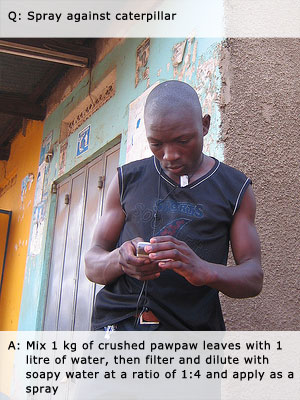
 . Written by Oona Burke, guest columnist; published on 19 June, 2009.
 This deployment option is great for large scale applications. In the area of dissemination and collection of mobile market information, I am aware of ITC’s Trade at Hand using similar deployment paths for the delivery of Market Alerts from trade support institutions to networks of exporters, and for the collection and analysis of local market information under the mCollect project.
 The second deployment option mentioned by Mr. Jonathan Jackson includes 1) local server connected to a phone, being able to talk to local clients and 2) client machines hitting the local server directly, or through the Internet. Small deployments are viable under this option. But deployments are subject to the hazards of thier small scale. Even small problems with the systems can become critical because they require specialised engineering skills. Such deployments are at risk of losing users’ interest when qualified support is not available on the ground. A market oriented project which might fall under this category is the Cambodia Crop Production and Marketing Project (CCPMP).
Neither stakeholders nor farmers currently work with or have a view on long-term marketing strategies to develop the small-scale horticulture sector. This makes it difficult to prioritise the marketing information needed to design and operate an MIS. The proposal by the workshop stakeholders was to enter into dialogue with the Ethiopian government to improve its centralised MIS used for statistical purposes, and to make it more accessible to farmers. The recommendation by the Dutch experts was to set up a business service centre to collect available historical data, including surveys and statistical information, and use this information in the development of marketing planning skills among small-scale farmers and governmental officers. This will enable farmers to efficiently use and sustain the technology currently in development.
 The background behind KACE is that it is a commercial enterprise seeking to facilitate the process of price discovery occurring the market exchange of agricultural products. The video footage covers the work of Godrey Fwamba who appears to work as an enumerator and his duties seem to involve daily visits to the Nairobi market. During those visits he collects prices from the local traders, then sends them back to his office via SMS, where they are made available to farmers. The role of enumerators is crucial for the successful implementation of mobile market information services. A dedicated network of extension workers is capable of collecting comprehensive price and avalability information from local markets, thereby enabling ICT solutions to deliver relevant information with potential for changing the behaviour and choices of market suppliers.
 In December 2008 Nokia launched in India a pilot range of information services, covering topics in Agriculture, English Language, General Knowledge and Astrology. The services are geared towards mobile phone users in emerging markets, particulatly in rural areas. Nokia has indicated that any successful initiatives in India will be expanded across selected countries in Asia and Africa.
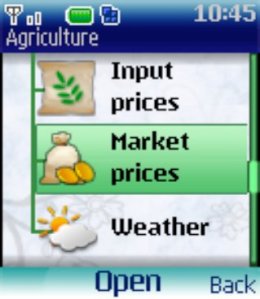 In terms of content, Nokia Life Tools is a range of agriculture information and education services designed for rural and small town communities in emerging markets. It uses an icon-based user interface that can display information simultaneously in two languages. SMS is used to deliver the content so GPRS coverage and fiddly settings are not required.
 MMD4D
MMD4D 