The Bottom Line Episode 2: Growth vs Mature Markets for ICT

TelecomTV and IBM present an informative overview of the current divide in the mobile market between mature and growing markets.The commentators emphasise two significant trends encountered in the mobile markets of developing countries. Firstly, there is a trend of emergence of innovative home-grown operators in developing countries and emergence of home-grown business models, better suited to the needs of low ARPU customers. Secondly, there is a trend in developing markets for the establishment of mobile (as opposed to Internet) data services for banking, commerce, healthcare and education.The particpants in the video include:- John Chambers, Chairman & CEO, Cisco- Prof. John Nkoma, Director General, Tanzania Communications Regulatory Authority- Kent Lupberger, Snr Mgr Portfolio & Technology Global ICT, World Bank- Dr. Tim Kelly, Lead ICT Policy Specialist, Infodev- Prof. Dora Nkem Akunyili, Minister Of ICT, Federal Republic Of Nigeria- Adrian Baschnonga, Senior Analyst, Global Telecoms, Ernst & Young- Mike Hill, VP Enterprise Initiative, IBM

Vodpod videos no longer available.

West African Forum on Agriculture and ICT

Below is a recent announcement by Burkina NTIC and IICD of the forthcoming forum ‘The marketing of agricultural products through ICT’ which is to be held in Ouagadougou. After coming across the announcement I was keen to join the Ning social network/ knowledge sharing platform which is available at http://agri-tic.ning.com/. At the forum I was trilled to find the training videos by TV Koodo, introducing the agricultural market information systems launched by Burkina NTIC and IICD.

The videos are in French and admittedly, my French is not good enough to warrant commenting on the content. But even considering only the visuals of the training materials I think that they clearly demonstrate the challenges to the deployment and introduction of ICTs in Africa. Communicating the relevance of the Internet, Web 2.0, mobile applications, etc. to end users such as African farmers and traders can be a considerable callenge. Enabling und users to find value in ICTs and convincing them to invest in pricey devices can be a challenge comparable to the development of technologies and their localisation to the languages, literacy levels and information needs of African users. This challenge is compounded in the case of the introduction of market services by the fact that users’ value from the service is rooted in network effects.

TV Koodo chooses puppet tv presenters as carriers of the instructional message. This choice demonstrates the significance of efforts to make e-/m- learning technologies more accessible and more responsive to the needs and educational backgrounds of African users. The coupling of learning technologies with ICT services geared towards enabling market transactions, could hold the key to the adoption, the popularity and the value derived from market services.

IICD: Social Network Used to Prepare West African Forum on Agriculture and ICT

Burkina NTIC has launched a social network platform to prepare West Africa’s first regional forum on marketing agricultural products through ICT. The event will take place 23-25 November in Ouagadougou, and the platform will help deepen the discussions and share the outcomes with a wider international audience. Burkina NTIC is the national ICT for development network.

Social Network Used to Prepare West African Forum on Agriculture and ICT
The typical method of collecting market price information in Burkina Faso.

Information exchange about farming techniques, markets and market prices is key to improving the agricultural sector. IICD has supported farmer organisations in Burkina Faso, Ghana and Mali since 1998 to help improve the production, processing and marketing of their produce through the use of ICT. Not without success. Earlier this year the Malian farmer organisation of COPRAKAZAN was awarded by the national government for doubling its profit and declared to be an example to other farmer organisations in the country.

The forum ‘The marketing of agricultural products through ICT’ aims to increase the impact of the lessons learned and build the national network for ICT and development in Burkina Faso. The event is organised by Burkina NTIC, in particular its ICT cluster Agriculture.

The organisers will collect best practice examples of marketing agricultural products through ICT, to understand where the opportunities are and to draw lessons for the future. Best practices will be gathered from Burkina Faso and neighbouring countries.

The forum will bring about 45 participants together from various agricultural institutions in Mali and Burkina Faso, and IICD project partners. Agriterra and the Swiss Agency for Development Cooperation SDC will also attend, as well as resource people from the SEND foundation in Ghana, IT company Manobi from Senegal, ANOPACI from Ivory Coast, and the regional trade platform ESOKO (TradeNet).

The Ning social network platform is being used to gather ideas and best practices from experts throughout the region to discuss at the forum. After the forum the platform will be used for further sharing and documenting of experiences and views on the marketing of agricultural products through ICT. A Ning platform is a free social networking tool to help people build their own online social or professional network. The platform is moderated by Burkina NTIC, and membership is open to all: http://agri-tic.ning.com/.

Mobile phones in rural development and agriculture

Here is a video dealing with the use of mobile phones in rural development and agriculture. The video was shot at the MobileActive08 conference in Johannesburg, organised by Katrin Verclas of the MobileActive network.

Ugo Vallauri, David Newman and Jonathan Campaigne discuss small farm productivity issues which are key to economic growth and poverty reduction. They discuss how farmers are not effectively linked to the larger industry and therefore how mobiles phones can be used to help with this area. Farmers use these phones which allow people to enter markets and improve access to partners thereby improving their likelihoods and food security.

Vodpod videos no longer available.

more about “Mobile phones in rural development an…“, posted with vodpod

The Economic Times: IBM’s ‘spoken web’ to ramp up Amul’s milk business

6 Oct 2009, 1304 hrs IST, Pankaj Mishra, ET Bureau Print

GUJARAT: Arvindbhai Bavajibhai Patel, a 47-year old milk farmer living in a village near Anand in Gujarat, could become an early user of perhapsone of the most important technology innovations developed in IBM’s research labs. ‘Spoken Web’, a new technology solution being evaluated by Amul, will allow users to browse the Internet and access information by merely speaking in a local language, without having to use any computer keyboard, or type any text. For Amul, which started with the objective of removing middlemen and allowing farmers to get the best price for their milk, the next mission is to empower milk farmers with information, which is relevant and served in a language they understand. Amul is hoping technology will help it solve some of the newer challenges emanating from much largerbusiness around $1.5 billion in revenues and more complex supply chain.

“I am not sure if I can speak and interact with a computer ever, but if it becomes possible to access information needed just through speech–it will be a great help for me and many others who cannot read and write,” Patel said. Officials at Amul are currently evaluating IBM’s ‘spoken web’ solution among other specific products for serving the farmers better by providing them with information about animal husbandry, cattle management and best practices in milk productivity improvements.

Gujarat Cooperative Milk Marketing Federation (GCMMF) serves around 2.79 million members, across 13,328 village societies, handling almost 11.22 million litres of milk every day. Earlier this year, increasing business complexity and need for becoming a more agile enterprise prompted Amul to sign a 10-year IT outsourcing contract with IBM, estimated to be worth around Rs 100 crore.

As Amul prepares to use IT for automating and integrating its complex business processes, newer technologies such as ‘spoken web’ will help India’s biggest dairy producer solve some of its unique problems and serve over 2.7 million milk farmers better.

Over next few months, Amul plans to deploy a common enterprise resource planning (ERP) software from SAP and also develop specific software solutions for helping the end customers and users access information about milk pricing, quality and cattle management. An ERP software will help establish a strong platform by automating and integrating different business processes across 13 milk unions, and serve real time data to the management and farmers.

“This will change the way we do business, as information will become knowledge, enabling us to do things in a better fashion,” said BM Vyas, managing director of GCMMF. Commenting on Rs 110 crore investments on new IT initiatives, he added that the efficiency should be able to pay for itself.

While an ERP software will help AMUL simplify its back end business processes, some innovative software applications such as ‘spoken web’ willmake transacting easier for farmers such as Bavajibhai Patel.

“We are always looking at the entire supply chain-from cow to consumer. There are several pilots going on focused on enhancing user experience and information access for end customers,” said Niraj P Garg, IT manager at GCMMF. IBM, which was selected by the union after some aggressive bidding by other tech vendors, has already started working on the blueprint.

“AMUL has very unique needs, and we have some innovative solutions from our labs apart from best practices from other dairy engagements to help them serve their customers better,” said Sandip Patel, managing partner of Global Business Services, IBM India. Globally, IBM serves dairy companies including Nestle and Kraft Foods of Australia.

“In the first phase over next 14-15 months, we will deploy ERP at the federation and atleast five unions,” Garg added. GCMMF plans to bring all of its 13 milk unions under a single ERP solution from SAP. Despite initial positive response from other milk unions, Amul faces challenges in terms of educating different users and making them embrace the new IT agenda. RS Sodhi, chief general manager at the federation has already formed a steering committee for overseeing the cooperative’s IT progress.

“Timely implementation of the solution, standardisation of different processes and older legacy systems are some of our biggest challenges,” said Sodhi. “The biggest benefit will be much higher speed of operations-for instance real time inventory data instead of a week-long update process,” he added.

IBM’s Patel added that AMUL officials have shown interest in some of the solutions developed by IBM labs in the areas of genetics and ‘spoken web’. “In a recent survey AMUL found that almost 30-40% of cows were not producing enough milk-now we have been working on solutions in our labs that can help manage, for instance, milk fat and enhance productivity,” Mr Patel added.

Meanwhile, for thousands of Amul members, what matters the most is the federation’s undiluted committment for their cause, and new technology initiatives at some level do seem to reflect that. “Over past few years we have seen Amul introduce newer systems including the automated milk fat-reader, which brought great transparency,” said Bavajibhai Patel. “We welcome more computers and other systems as long as they make our lives simpler.”

The Economist: Mobile marvels

Sep 24th 2009

From The Economist print edition

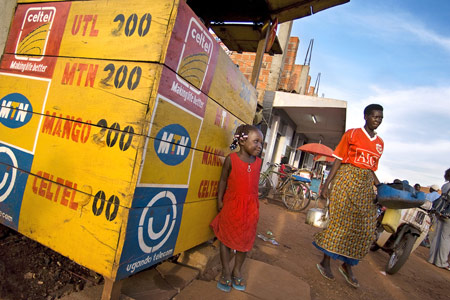
BOUNCING a great-grandchild on her knee in her house in Bukaweka, a village in eastern Uganda, Mary Wokhwale gestures at her surroundings. “My mobile phone has been my livelihood,” she says. In 2003 Ms Wokhwale was one of the first 15 women in Uganda to become “village phone” operators. Thanks to a microfinance loan, she was able to buy a basic handset and a roof-mounted antenna to ensure a reliable signal. She went into business selling phone calls to other villagers, making a small profit on each call. This enabled her to pay back her loan and buy a second phone. The income from selling phone calls subsequently enabled her to set up a business selling beer, open a music and video shop and help members of her family pay their children’s school fees. Business has dropped off somewhat in the past couple of years as mobile phones have fallen in price and many people in her village can afford their own. But Ms Wokhwale’s life has been transformed.

Ms Wokhwale prospered because being able to make and receive phone calls is so important to people that even the very poor are prepared to pay for it. In places with bad roads, unreliable postal services, few trains and parlous landlines, mobile phones can substitute for travel, allow quicker and easier access to information on prices, enable traders to reach wider markets, boost entrepreneurship and generally make it easier to do business. A study by the World Resources Institute found that as developing-world incomes rise, household spending on mobile phones grows faster than spending on energy, water or indeed anything else.

The reason why mobile phones are so valuable to people in the poor world is that they are providing access to telecommunications for the very first time, rather than just being portable adjuncts to existing fixed-line phones, as in the rich world. “For you it was incremental—here it’s revolutionary,” says Isaac Nsereko of MTN, Africa’s biggest operator. According to a recent study, adding an extra ten mobile phones per 100 people in a typical developing country boosts growth in GDP per person by 0.8 percentage points.

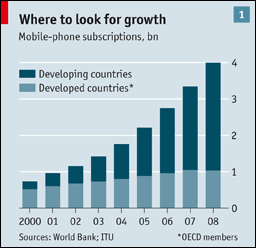
In 2000 the developing countries accounted for around one-quarter of the world’s 700m or so mobile phones. By the beginning of 2009 their share had grown to three-quarters of a total which by then had risen to over 4 billion (see chart 1). That does not mean that 4 billion people now have mobile phones, because many in both rich and poor countries own several handsets or subscriber-identity module (SIM) cards, the tiny chips that identify a subscriber to a mobile network. Carl-Henric Svanberg, the chief executive of Ericsson, the world’s largest maker of telecoms-network gear, reckons that the actual number of people with mobile phones is closer to 3.6 billion.

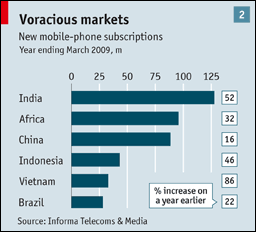
But exact numbers are hard to come by, not least because of the continued rapid growth in the global number of subscribers. In the year to March 2009 an additional 128m signed up in India, 89m in China and 96m across Africa, according to TeleGeography, a telecoms consultancy. Numbers in Indonesia, Vietnam, Brazil and Russia also grew rapidly (see chart 2). China is the world’s largest market for mobile telephony, with over 700m subscribers. India is adding the biggest number each month: 15.6m in March alone. And Africa is the region with the fastest rate of subscriber growth. With developed markets now saturated, the developing world’s rural poor will account for most of the growth in the coming years. The total will reach 6 billion by 2013, according to the GSMA, an industry group, with half of these new users in China and India alone.

All this is transforming the telecoms industry. Within just a few years its centre of gravity has shifted from the developed to the developing countries. The biggest changes are taking place in the poorest parts of the world, such as rural Uganda.

Not the usual suspects

Three trends in particular are reshaping the telecoms landscape. First, the spread of mobile phones in developing countries has been accompanied by the rise of home-grown mobile operators in China, India, Africa and the Middle East that rival or exceed the industry’s Western incumbents in size. These operators have developed new business models and industry structures that enable them to make a profit serving low-spending customers that Western firms would not bother with. Indian operators have led the way, and some aspects of the “Indian model” are now being adopted by operators in other countries, both rich and poor. This model provides new opportunities, especially for Indian operators. The spread of the Indian model could help bring mobile phones within reach of an even larger number of the world’s poor.

The second trend is the emergence of China’s two leading telecoms-equipment-makers, Huawei and ZTE, which have entered the global stage in the past five years. Initially dismissed as low-cost, low-quality producers, they now have a growing reputation for quality and innovation, prompting a shake-out among the incumbent Western equipment-makers. The most recent victim was Nortel, once Canada’s most valuable company, which went bust in January. Having long concentrated on emerging markets, Huawei and ZTE are well placed to expand their market share as subscriber numbers continue to grow and networks are upgraded from second-generation (2G) to third-generation (3G) technology, notably in China and India.

The third trend is the development of new phone-based services, beyond voice calls and basic text messages, which are now becoming feasible because mobile phones are relatively widely available. In rich countries most such services have revolved around trivial things like music downloads and mobile gaming. In poor countries data services such as mobile-phone-based agricultural advice, health care and money transfer could provide enormous economic and developmental benefits. Beyond that, mobile networks and low-cost computing devices are poised to offer the benefits of full internet access to people in the developing world in the coming years.

This special report will examine each of these three trends in turn. Each one is significant in itself but also has consequences for rich as well as poor countries. Together they could start a second wave of mobile-led economic development as powerful as that prompted by the original launch of mobile phones. Their spread in poor countries is not just reshaping the industry—it is changing the world.

via A special report on telecoms in emerging markets: : Mobile marvels | The Economist.

The Economist: The power of mobile money

Sep 24th 2009
From The Economist print edition

ONCE the toys of rich yuppies, mobile phones have evolved in a few short years to become tools of economic empowerment for the world’s poorest people. These phones compensate for inadequate infrastructure, such as bad roads and slow postal services, allowing information to move more freely, making markets more efficient and unleashing entrepreneurship. All this has a direct impact on economic growth: an extra ten phones per 100 people in a typical developing country boosts GDP growth by 0.8 percentage points, according to the World Bank. More than 4 billion handsets are now in use worldwide, three-quarters of them in the developing world see our special report. Even in Africa, four in ten people now have a mobile phone.

With such phones now so commonplace, a new opportunity beckons: mobile money, which allows cash to travel as quickly as a text message. Across the developing world, corner shops are where people buy vouchers to top up their calling credit. Mobile-money services allow these small retailers to act rather like bank branches. They can take your cash, and (by sending a special kind of text message) credit it to your mobile-money account. You can then transfer money (again, via text message) to other registered users, who can withdraw it by visiting their own local corner shops. You can even send money to people who are not registered users; they receive a text message with a code that can be redeemed for cash.

By far the most successful example of mobile money is M-PESA, launched in 2007 by Safaricom of Kenya. It now has nearly 7m users—not bad for a country of 38m people, 18.3m of whom have mobile phones. M-PESA first became popular as a way for young, male urban migrants to send money back to their families in the countryside. It is now used to pay for everything from school fees (no need to queue up at the bank every month to hand over a wad of bills) to taxis (drivers like it because they are carrying around less cash). Similar schemes are popular in the Philippines and South Africa.

Banking on it

Extending mobile money to other poor countries, particularly in Africa and Asia, would have a huge impact. It is a faster, cheaper and safer way to transfer money than the alternatives, such as slow, costly transfers via banks and post offices, or handing an envelope of cash to a bus driver. Rather than spend a day travelling by bus to the nearest bank, recipients in rural areas can spend their time doing more productive things. The incomes of Kenyan households using M-PESA have increased by 5-30% since they started mobile banking, according to a recent study.

Mobile money also provides a stepping stone to formal financial services for the billions of people who lack access to savings accounts, credit and insurance. Although for regulatory reasons M-PESA accounts do not pay interest, the service is used by some people as a savings account. Having even a small cushion of savings to fall back on allows people to deal with unexpected expenses, such as medical treatment, without having to sell a cow or take a child out of school. Mobile banking is safer than storing wealth in the form of cattle (which can become diseased and die), gold (which can be stolen), in neighbourhood savings schemes (which may be fraudulent) or by stuffing banknotes into a mattress. In the Maldives many people lost their savings in the tsunami of 2004; it hopes to introduce universal mobile banking next year.

Financial innovation has a bad reputation at the moment, because exotic derivatives were one of the causes of the credit crunch. But mobile money and other new ideas that could help the poor (see article) provide a useful reminder that financial innovation in itself is not always a bad thing.

Given all of its benefits, why is mobile money not more widespread? Its progress has been impeded by banks, which fear that mobile operators will eat their lunch, and by regulators, who worry that mobile-money schemes will be abused by fraudsters and money-launderers. In many countries mobile money has been blocked because operators do not have banking licences and their networks of corner-shop retailers do not meet the strict criteria for formal bank branches. And some mobile-money schemes that have been launched, such as one in Tanzania, failed to catch on. As recently as a year ago people wondered whether M-PESA’s success was a fluke.

Out of Africa, always something new

But in recent months there have been some more hopeful signs. Kenya’s success story has demonstrated mobile money’s potential, and its benefits are starting to be more widely appreciated. More enlightened regulators are no longer insisting that these services meet the rigid rules for formal banking. Some banks, meanwhile, have come to see mobile money not as a threat but as an opportunity, and are teaming up with operators. And phone companies have studied Kenya closely to learn how to establish and market a successful mobile-money scheme. MTN, Africa’s biggest operator, has launched a mobile-money service in Uganda in conjunction with Standard Bank; it appears to be doing well. MTN is fine-tuning its service in Uganda before rolling it out across Africa.

Banks and regulators elsewhere should take note. Instead of lobbying against mobile money, banks should see it as an exciting chance to exploit telecoms firms’ vast retail networks and powerful brands to reach new customers. Tie-ups between banks and operators will help reassure regulators. But they, too, need to be prepared to be more flexible. People who want to sign up for mobile-money services should not, for example, have to jump through all the hoops required to open a bank account. Concerns about money-laundering can be dealt with by imposing limits (typically $100) on the size of mobile-money transactions, and on the maximum balance. And inflexible rules governing the types of establishments where cash can be paid in and taken out ought to be relaxed.

Mobile money presents a shining opportunity to start a second wave of mobile-led development across the poor world. Operators, banks and regulators should seize it.

via Telecoms: The power of mobile money | The Economist.

Infrastructure is Getting Smart

So recently I’ve been travelling for a bit after taking some time off in August. But after a short spell of flu I am back online and looking to point out interesting developments in the areas of ICT4D, mobile technology and technology enabled markets.

Below I am bringing to your attention a program from the Telecom TV series “The Bottom Line” and Ethan Zuckerman’s presentation from the Ars Electronica 2009 in Linz, Austria. I thought that the two video pieces fit together because they highlight the changing concept of infrastructure in the context of pervasive information and telecommunication technologies, and its complexity.

“The Bottom Line ” stresses the point that previously infrastructure used to be understood by most as buildings, roads, railways, shipping and airline routes, pipelines, financial services; and by some as communication networks, landline and wireless networks, data centres, computing power, software, routers, bandwidth, the Internet and so on. Currently, all these concepts of infratructure are converging. Mobile systems are connecting roads, the vehicles travelling on them and the stocks they are transporting. Mobile money is facilitating the flow of these stocks. The world is changing by the infrastructure getting smarter. The transformation provides a promise of a much more integrated world but also it introduces challenges to network operators and service providers.

Vodpod videos no longer available.

more about “TelecomTV | Video | The Bottom Line E…“, posted with vodpod

The presentation by Ethan Zuckerman from the Ars Electronica 2009 held in Linz, Austria also sets off with infrastructure as its starting point. Mr Zuckerman considers early attempts to map the Internet as the “electronic super highway”. He points out that currently the idea of mapping the Internet by means of tracing the whereabouts of physical infrastructure is outdated. Instead, he considers the concept of the Cloud and presents the idea of mapping the Internet by means of mapping the flows of technology use, as well as the lack thereof. Mr Zuckerman points out that the perceived level of globalization diverges from the actual level of out-of-context, non-local information we tend to seek. He suggests that there are areas of the world e.g. Nigeria, receiving far inadequate attention by information users and providers.

Vodpod videos no longer available.

more about “Ethan Zuckerman: Mapping the Cloud / …“, posted with vodpod

Mobile Market Design for Development

Design a site like this with WordPress.com
Get started