Category Archives: Observations

Mobile Use Behaviour in Liberia

During my work with ITC on Liberia, I was in touch with field contacts and I had the opportunity to discuss the state of the mobile telephony sector there, the available services and their prices. One of my reliable contacts there shared with me the following information. She said, that the average amount spent on pre-paid mobile phone cards (aka scratch cards) in Liberia is $5 per month. Apparently, most of the $5 of airtime credit  is used up within a few days of scratching the card. How could we possibly account for such behaviour? I’ve been thinking up hypotheses about it:

  1. One obvious suggestion would be that people go into the trouble and expense of getting the scratch card because they have some particular significant information need, or emergency which requires conversations at considerable length. Then the question becomes, how is it that these events re-occcur with considerable regularity, approximately every month?
  2. A variant of the same scenario would be the use of the airtime for a short but expensive conversation. For example, parents in Liberia calling their children overseas.
  3. A completely differnet way of looking at it, would relate to the nature of the social networks people are part of. Say, for example, if someone has enough money to buy credit then he/she is expected to get in touch with many people in order to re-affirm their identity as part of a group.
  4. Yet another scenario would be that once someone had airtime credit on their phone, the airtime credit is considered communal. So the people in their immediate surrounding feel entitled to use the phone.

What do you think? Any suggestions on the matter?

Warehouse Receipt Systems

Here is a very informative educational documentary on Warehouse Receipt Systems produced by the Technical Centre for Agricultural and Rural Cooperation ACO-EU (CTA), Agence Français de Développementé (AFD) and the Natural Resources Institute (NRI).

The film documents a study visit to Tanzania and South Africa. Even though the film provides plenty of useful information, its authors make sure to note:

“The examples presented in these two countries are typified by particular experiments and contexts and cannot simply be transposed to other cases. Nonetheless there are a great number of lessons to be learnt and which could provide guidancefor certain aspects of orientation and initiatives in your respective countries.”

I personally think that the documentary illustrates theoretical issues which are encountered the world over, and are not specific to any particular context. The film raises questions regarding trust, confidence, contractual completeness, regulation, product quality and standardisation. Even though in this documentary the issues emerge with regards to warehouse receipt systems, they are intrinsic characteristics of any market negotiations (and eventual transactions) taking place without the double coincidence of time and place. The film focuses on futures markets i.e. transactions without coinsidence in time. Conversely, market negotiations carried out via mobile phones, or other ICTs exemplify transactions without coinsidene in place.


Warehouse receipt systems were developed in the 1990s as a response to farmers’ income instability due to price fluctuations resulting from liberalisation. Since prices tend to be low during harvest periods and to subsequently rise, warehouse reeipt systems provide a solution by storing commodities for the suration of the low price season. Price volatility and lack of quality standards are attributed to market liberalisation in the agricultural sector.

Warehouse receipt systems operationalise the food supply chain and involve the following stakehoders:

  • farmers (individuals or cooperatives)
  • warehouse operators
  • financial institutions
  • exporters, traders

Tanzania

The warehouse receipt system was introduced in Tanzania in 2005 with the pilot crops of coffee and cotton. It enables farmers to receive loans and assure the quality of their produce. The system allows coffee producers (individuals or cooperatives) to store their coffee in a silo. Upon the receipt of the coffee the producers are issued with 2 certificates: certificate of title for them to keep and certificate of pledge to provide to third parties. These are normally cooperative or commercial banks participating in the system. The certificates of deposit allow farmers to induce confidence in the financial institutions. They also enable the banks to reach a new set of customers for financial services.

The warehouses also ensure the transparency of the commodity marketing system. Commodities are classified according to quality and offered for sale at regional and sub-regional markets. For example, coffee is graded and offered for sale at auctions administered by a public organisation.

Producers in other sectors, such as the Chawampu rice growers cooperative, have followed suit. Representatives of the cooperative introduce a model whereby they are able to offer 70% of market value of deposited quantities of rice. Subsequently, after selling the crop and substracting the administrative costs the cooperative, they provide a second payment to the members of the cooperative. Farmers use any additional income in order to buy seeds, fertilizer and to develop off-season activities.

The warehouse receipt systems functions well due to the high price differentials between the post-harvest season and the hungry season. The main challenges to the warehouse receipt system remain:

  • providing adequate infrastructure
  • ensuring warehouse security
  • reinforcing producers’ organisations
  • increasing the number of quality control specialists
  • reducing operating costs

South Africa

South Africa presents an advanced example based on the warehouse weceipt system because it has a functioning futures market in agricultural commodities. The SAFEX was established in the 1990s during an intense period of market liberalisation.

The advantages of South Africa include its good financial infrastructure for the settlement of deals and the quality of  its physical infrastructure enabling the trading, warehousing and transportation of the commodities. Critical is the legal enforcability of contractual rights and of legal receipt rights. Thereby, people are able to take the necessary steps and to manage their post-harvest risk well in advance.

SAGIS acts as an information intermediary for the South African commodity markets. It collects and distributes local consumption and up-to-date market information. The agricultural marketing giant SENWES provides mobile phone access to hourly prices of grain via SMS. Even though it is not typical of Africa in favouring large scale farmers, the South African warehouse receipt experience provides a useful benchmark for implementations elsewhere.

Service Syndication and Nokia Life Tools

This video was filmed at the Digital World Forum, W3C workshop in Maputo, Mozambique 1-2 April, 2009. Mr. Paavo Krepp, Head of Emerging Market Services, Africa and Middle East of Nokia, South Africa stresses the importance of content for the creation of adequate mobile information services in developing countries. Given the low disposable incomes of users of agricultural information services, Mr. Krepp emphasises the importance of enhancing the relevance of the delivered content by providing dynamic time and location specific information. He also discusses the customisation of mobile services to local perceptions, languages, understandings of iconography, and dynamic mappings of crops.

In the mobile sector, collaboration among content providers with local and domain knowlegde, telecom operators and device manufacturers appears to be key for the successful provision of information services for the agricultural sector, including advisory and marketing services. The recent partnership between Nokia and Reuters Market Light for the Nokia Life Tools pilot in India is a great example of syndication in the delivery of mobile services for users in developing countries. I expect that we should be seeing more partnerships of this type if mobile technology is to deliver on its promise of improving the livelihoods of smallholder farmers in developing countries. Nowadays, these people are facing numerous challenges ranging from erratic weather, due to climate change, to food security. Working collaboratively towards the provision of adequate technology-based information services for their needs seems the very least we could do.

Liberian Markets: Part 4

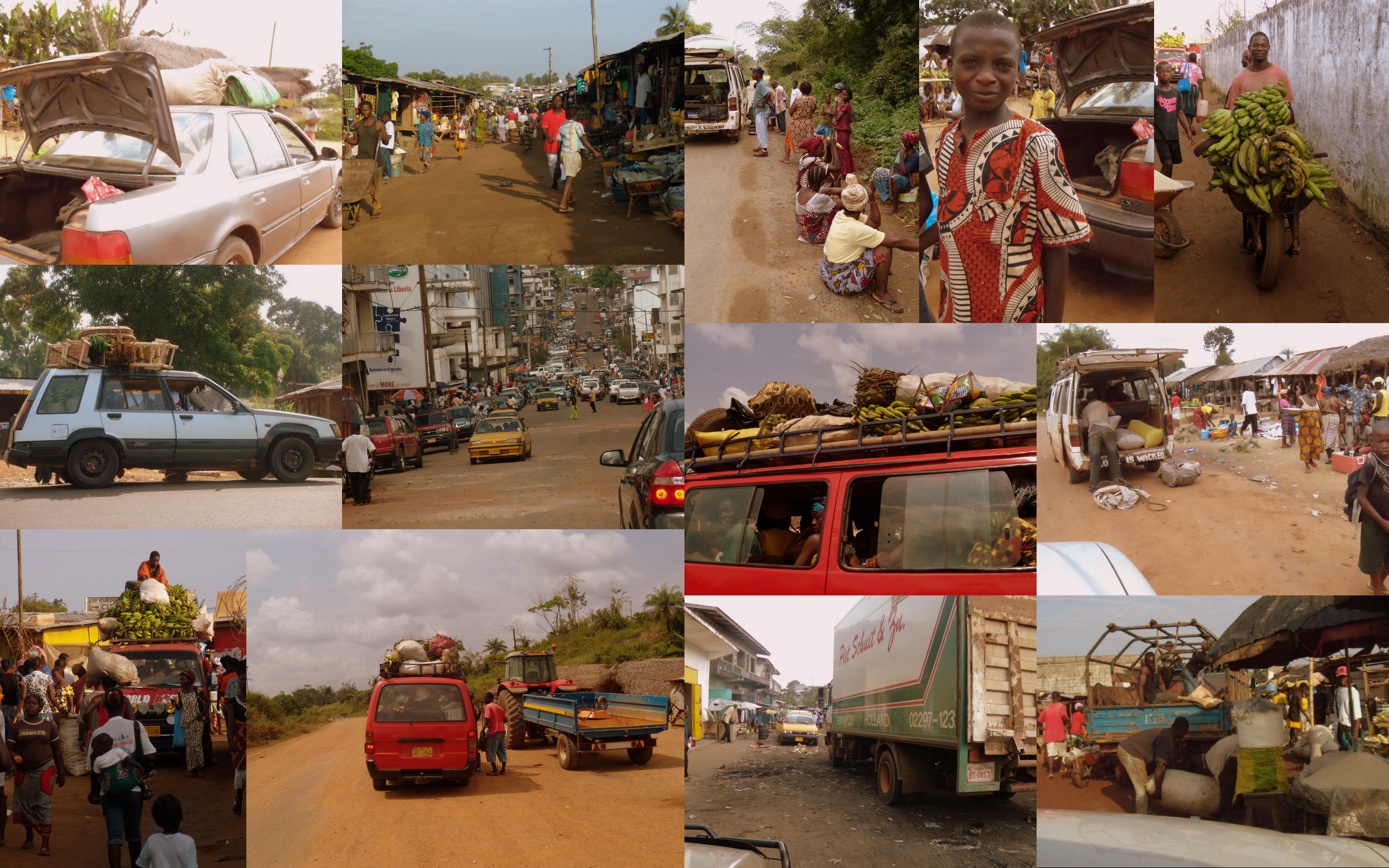
Transportation appears to be a significant obstacle for both buyers and sellers of agricultural produce in Liberia. I have been able to observe producers from the countryside arriving at the wholesale Red Light market in Monrovia as passengers accompanying their loads of produce. At the Red Light producers seek to sell their products to market women, who in turn re-sell the goods to market women acting as retailers. These are the market women selling at markets such as Rally Time, Nancy Doe Jorkpentown, Waterside, Barnardsville and Paynesville.  I was not able to see neither producers, nor market women (wholesalers or retailer) who own their own transportation vehicles. transport

Moving outside ot Monrovia, roads in Liberia serve not only as trade flow arteries, but also as significant market venues. Inhabitants at roadside villages offer for sale charcoal, palm oil, red oil, river fish, bananas, plantain, baskets, wooden furniture (chairs, benches). The flow of traffic thorough roadside villages is seen as constant flow of customers.

ICT Update, Issue 47: Market information systems

ictupdate
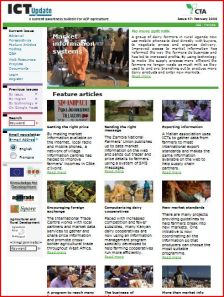
The newly published Feb 2009 issue of ICT Update (47) features is dedicated to  the topic of Market Information Systems, recent implementations and trends in their use in developing countries. ICT Update reviews many ICT4D projects targeted at the use of ICTs for the improvement of market access for farmers in developing countries. Some of the initiative featured in the issue include:

  • National Association of Agricultural Producer Organizations of Côte d’Ivoire (ANOPACI)’s market information system called système d’information sur les marchés (SIM -ANOPACI). SIM -ANOPACI works through a network of village information centres (points d’information villageois, or PIVs) to gather, process and disseminate agricultural information. This includes prices, offers to buy or sell, availability of products and comments on market trends for particular products.
  • Zambia National Framers’ Union (ZNFU) uses an SMS announcement service in order to inform rural farmers about market prices for their crops.
  • Malian fruit and vegetable export organization, Fruit et Légumes du Mali (Fruiléma) use of GPS, cameras and computer technology in order to monitor mango harvests and their compliance to international quality standards.
  • Coopworks, information management system for Kenyan milk cooperative. The systems assists cooperatives in their tracking of daily, weekly and monthly deliveries of milk by any farmers. The system can compile reports based on collection routes, farm location and regions.
  • Kenya Agricultural Commodity Exchange (KACE)’s market information and linkage system (MILS). The system provides reliable and timely market information and to link farmers to the markets by finding matches for offers and bids on agricultural goods. The system uses market information points located in rural markets throughout Kenya.
  • The use of FrontlineSMS for the delivery of market information by FIAGRO (Agricultural Technology Innovation Foundation) in El Slavador, as well as by Mercy Corps in Aceh for their service MarketInfo-SMS.

I was also able to write myself about ITC’s Trade at Hand initiatives. My article Encouraging Foreign Exchange is focused particularly on the pilot of the mCollect system in Burkina Faso, Mali, Senegal, Benin and Ghana.

I shall be useing the newly available ICT Update information about market information system in developing countries in order to inprove the list of ICT4D market projects.

Location Information at CellBazaar, Bangladesh

I have been taking a good look at the website of Grameenphone’s CellBazaar in Bangladesh. The CellBazaar initiative is certainly worth some consideration because it is one of the better established mobile marketplaces.

CellBazaar offers multiple channels for checking the listings and for submission. The mobile channels include SMS and WAP. Concurrently, all the sell osms-buy1ffesms-sellrs submitted within the last 30 days are available for viewing online.

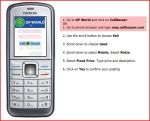
I have been particularly interested in the CellBazaar tutorials for the viewing of the available offers via mobile technology and for the submission of offers. The tutorials feature the procedures for announcing a sell lead and for checking the sell leads. The procedures (SMS Buy, SMS Sell) involve the sending of 4 text messages in order to sell, and of 5 messages in order to buy. In response, the user of the system receives lists of the available metacathegory, cathegory, sub-cathegory and price range options. The user makes a choice by texting to CellBazaar the number of the selected option.

wap-buywap-sellThe buying and selling procedures are less clumsy when the users have WAP trechnology at their disposal. The buying and the selling procedures are explained respectively at WAP Buy and WAP Sell.

Considering the SMS and WAP procedures one fact sticks out. In neither selling procedures (SMS or WAP) is the user required to specify his/her location. In the WAP Buy procedure once a buyer chooses the sub-cathegory of goods he/she is interested in, he/she needs to specify a location and a price range. In the SMS Buy procedure the is required to specify a price range. This all leaves the question open as to how CellBazaar is able to know the location of its users. Is anyone aware of what location technology they are using? If CellBazaar do indeed infer the location of their users without asking them to confirm it, that seems to me a rather poor practice. If it is otherwise, I would very much appreciate hearing about it.

Liberian Markets: Part 3

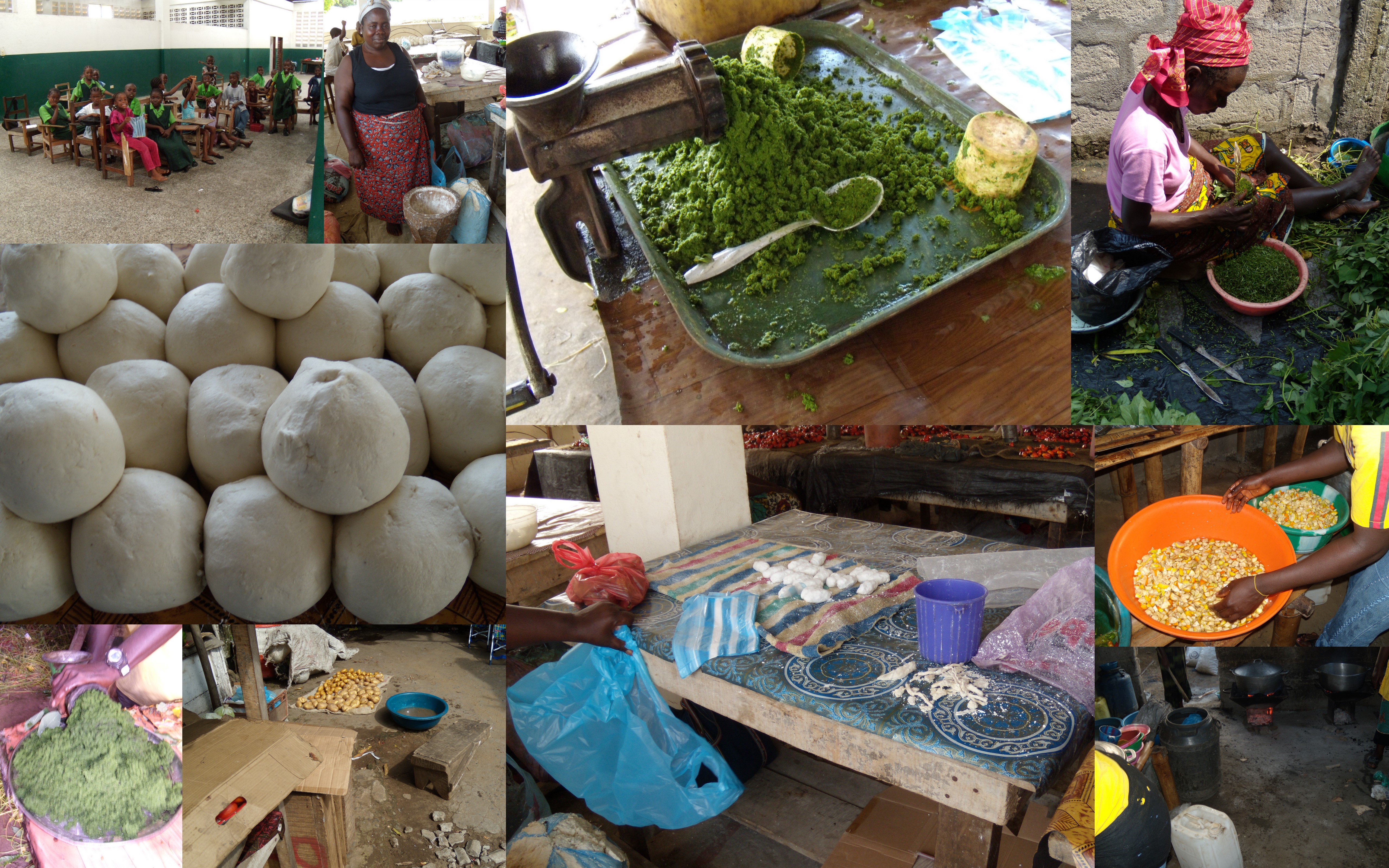
Services are offered at Liberian markets independently, or as adding value to other products.Independent services include services provided by the Liberian Marketing Assoiciation such as schools at the premises and child care. They also include catering services, provided by individual cooks offering food to people visiting the markets as part of their daily routines.

servicesSome market traders are involved in the provision of added value services complementing their main marketable products. Generally, the services appear to be attached to low value products such as cassava dust balls, starch, ground greens, etc. Greens, for example are a fascinating case. They are very perishable, low level products. But the individuals involved in their provision seem to possess considerable entrepreneurship, initiative and resilience. Even though they have modest means, they are able to procure the greens without need for access to credit. In the procurement process they visit multiple farms, monitor the readiness of the greens for harvest, and often exchange current information about the quality of greens available at different farms via mobile phones. As greens are perishable and usually are ready for harvesting every 6 months, the monitoring process is rather demanding. Once they procure the greens, the traders add to the value by grinding the cassava leaf and by cutting the fever leaf. Thus they are able to offer their customers greens in a state suitable for immediate cooking.

Mobile Phones in Liberia Part 1

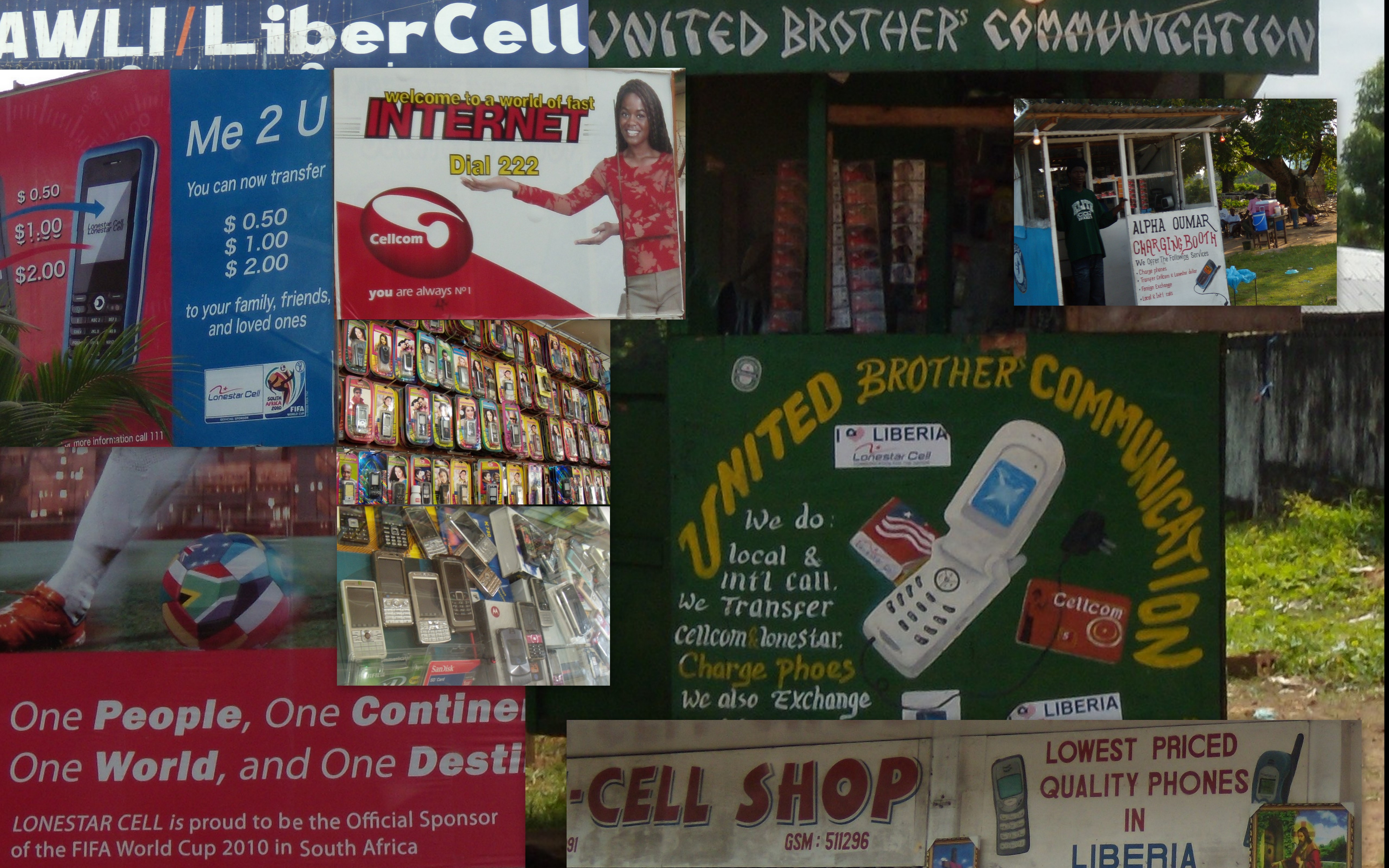
Mobile telephony is widely used in Liberia! Just like in many other places your mobile phone number is the information about you people are interested in knowing immediately after hearing your name.

Mobile telephony has become a major part of the daily life of people in cities, as well as of those of rural dwellers. While the constant occurrence of unforeseen circumstances can be seen as the main reason for the use of mobile phones in cities, in rural areas mobile phones are used mainly because of their communication capabilities. People in the countryside are using mobile phones in order to overcome their geographical removal from close relatives, services (medical, emergency), or events. They use mobile phone to get away from spatial isolation.

I suppose there might be other media used in Liberia for communication in the rural areas. Radio would be a prime candidate. It is a media that can be a very successfully build the social fabric across distances. What is the level of radio provision in rural Liberia? Does anyone know? Because of the devastation in the country during the civil war conflict, fixed line telephony is not a viable substitute to mobile telephony in Liberia. Even though in Monrovia I was able to see a few fixed line telephones, quite unlike mobile phones I was not able to see them in use.

mobile-telephony

Follow-up on Liberian Markets Parts 1 & 2

After my recent posts with regards to quantity measures, scales, weights, packaging etc. I have been alterted to the article by Kiringai Kamau in the recent issue of Information Technology in Developing Countries, Volume 18, No. 3, October 2008. Kiringai Kamau describes the impact of an electronic measurement system at a milk procurement station in Githunguri, Kenya. The author also mentions many concerns, vested interests and conflicts which influence the actions of both farmers (sellers) and procurers (buyers) in the absence of an indisputable measurement system.

“As you may agree, farmers’ earnings are not always proportionate to what is paid to them by the processors to whom they sell their produce. The processor is normally paid more and can at his whim inflate prices to suit his financial appetite, thereby creating inflation that affects those outside the processing arena. To make matters even worse, the poor farmer normally delivers more produce but the records are falsified by middlemen or intermediaries who collect the produce from farmers, and then deliver or sell whatever they have collected from the farmer to the processors. Unfortunately, the farmer is hostage to this system and has nowhere to take his produce besides to the same unscrupulous clerk or middleman who steals from him with impunity.

When the clerks from procuring intermediaries weigh the produce, they traditionally record a farmer’s delivery on a manual delivery ticket. If we take the case of milk which is our latest sector as a company to focus automation on, an illiterate farmer will lose milk:

  • At the weighing point where the scale may be deliberately mis-calibrated, and is always rounded downwards, and
  • At the produce delivery transcription level.

This inefficiency and resultant loss of effective weights against which payment is made, is repeated at every transcription point where there are clerks, before the actual final record against which payment is made has been captured. When the organization procuring the produce is a farmer cooperative as happens in the cases we have been dealing with, the managers may know that there is a problem of this nature but they too are held hostage by the clerks and their system of operating.

The challenge lies in the fact that most farmers are illiterate and may not be able to tell when clerks cheat on the reading of the scale or if they transcribe the wrong reading from the scale for their records. Indeed, even when they can read or write, the clerk can choose to take the wrong weight against which the literate farmer may have no recourse. Unfortunately, whatever the error, farmers have nowhere to turn to and are forced to develop some blind faith in the representative of the organization that procures their agricultural produce out of which they get their payment. Otherwise they will not be able to sell to anyone at all! Smallholder farmers may not complain, and when they do, they will not let the fraudulent clerk know in order to avert being blacklisted.

Even when the clerk is honest, the common analog scale normally used by the procuring institutions is calibrated to the nearest 0.5 of a kilogram. This means that in the case where the analog scale is used, clerks still have room to either round the readings downwards or upwards depending on their own whim. At times, records are lost by the farmers so that whatever is finally paid to them may not necessarily be what is due to them but rather what the clerks in the purchasing organization may decide is the correct rounded approximation.

Everything therefore relies on a procurement-payment system that is controlled by people other than the resource owner – the farmer. The extra weighed produce deliveries (derived from the aggregation of rounded readings or deliberate transcription errors) is then transferred through records so that payments are made to a rogue collaborating farmer who in the end oils the chain of thieving clerks, based on whatever may be their agreed formula. Though the farmers and managers in the procuring organization know that this scenario holds, they normally have no way of catching the thieves. Promoting more productivity at the farm level does not help in empowering poor rural communities, where wealth is most needed. And no matter what effort is made, poor rural farmers continue being poor. The process based technology that we evolved addresses this.

Our technology innovation, which is a digital handheld scale, weighs to the closest 0.01 of a kilogram of agricultural produce. Using electronic storage that downloads the data to a centralized database, and linking the scale memory to an electronic load cell, the scale is able to:

  • Weigh accurately to the nearest 0.01 of a Kilogram
  • Store farmer records in a Read Only Memory
  • Get powered through stored-electrical-power to make the scale memory/storage operate away from grid power
  • Through the power of a customized firmware designed to mimic the operations of the activities being addressed, automatically capture farmer records and their weighments
  • Capture and transfer farmer records on a farmer smartcard that can be used in input stores and retail outlets with credit arrangements with the produce buying institution/cooperative

Interfacing this scale with a computer enables the data from the scale to be transferred to an application that then updates records pertaining to payrolls for farmers and the procuring company’s internal staff. Farmer records are captured into the scale at the beginning of a field activity so that only real and authentic farmers can weigh their produce using the custom digital scale. This then removes the need for manual records and the control that has hitherto been in the hands of clerks that sell excess milk or tea in their own names or jointly with others.

This is then followed by data encryption so that data is not intelligible to the office clerks within the procuring institution. This forestalls any potential for data manipulation through manual effort. Electronic data capture then ensures that the processing of the farmers’ produce deliveries is done and records updated on a daily basis. A portable thermal printer that is strapped on the weighing clerk’s belt allows records that a farmer who needs a printed delivery ticket (a receipt of his milk delivery) to be printed. Data so collected and downloaded into a centralized server makes it available for remote querying by other parties such as the farm owner or management so long as such parties have the necessary authentication. Where the futures price is known, a farmer can take credit based on his produce delivery or obtain credit from a collaborating store using the farmer smartcard.

The above model has been under implementation for the last eight years in one of the dairy smallholder cooperatives, Githunguri Dairy, which started in year 2000 when they could only pay their farmers Ksh. 5,000,000 a month. Today they pay their farmers in excess of Ksh. 120,000,000 a month with an average monthly income of Ksh. 8,500 a farmer, an income that is close the basic salary of a teacher. The impact of this effort has been that the chairman of this cooperative was rewarded in the last general election with a vote to represent the constituency where the cooperative is based. The campaign story was the exemplary leadership that he has demonstrated through his strengthening of income generation ability that the smallholder farming community enjoys. They laud the transparent handling of milk records and payment which we know is associated more with the technology than the man. But indeed it is his far sighted thinking and the desire for an impact that he allowed technology to be tried in a rural area.”

Liberian Markets: Part 2

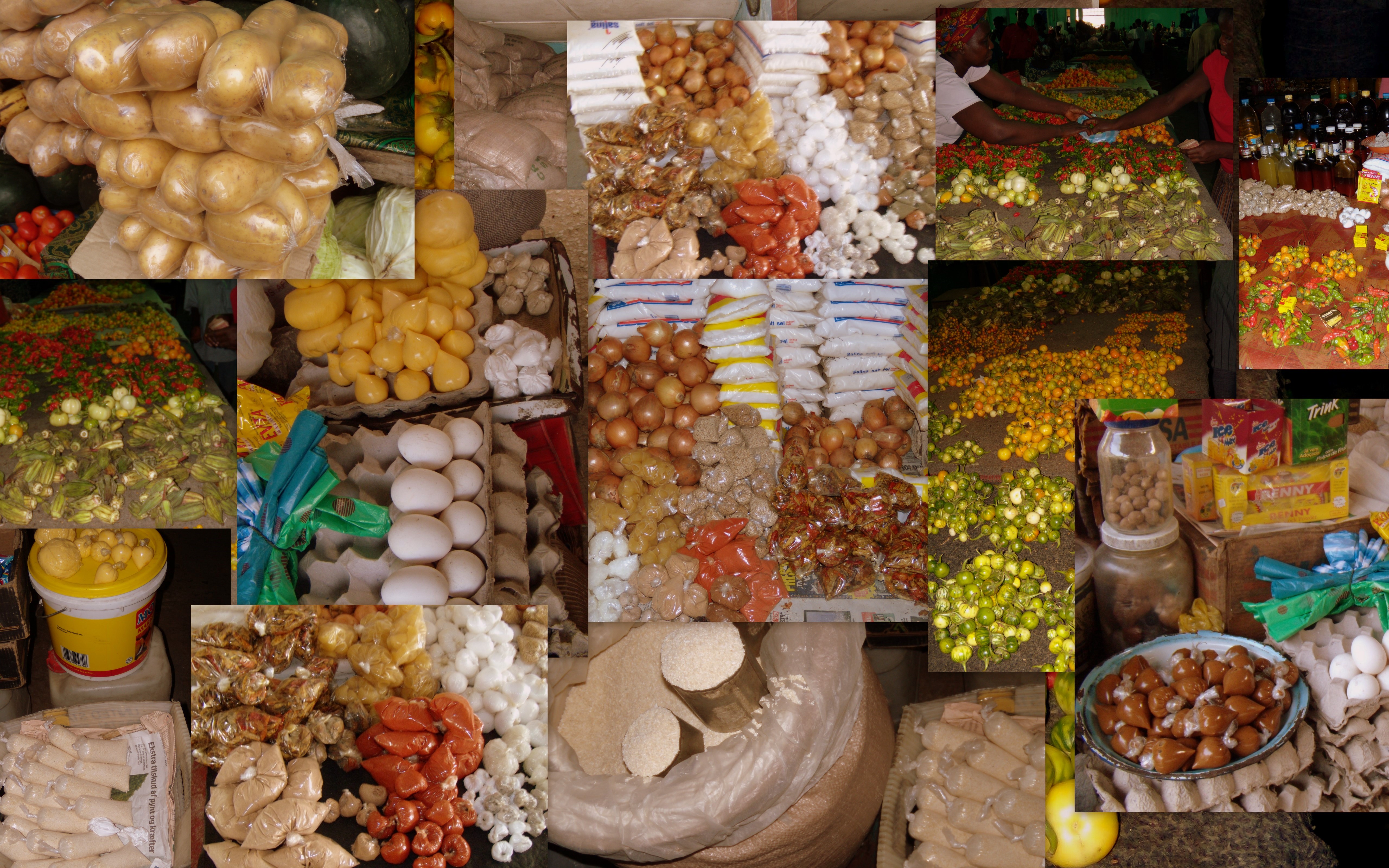
Another observation about Liberian markets concerns the way goods are exhibited. Generally, goods are arranged in terms of piles. Piles can be bigger, or smaller depending on the monetary value asked for them. For example, bird eye chilli pepper can be sold in regular piles, or in smaller piles sufficiently big for the cooking of a single serving of soup. Similarly, imported or manufactured food products such as spices and and condiments are repackaged into different sized sachets. For example, tomato puree comes into LBD 2 and LBD 5 sachets. Can anyone help me with some more examples? Butter? Peanut butter? Red pepper? Black pepper? Salt? Sugar?

packaging

The variety and the nature of the packaging used at Liberian markets is generally in accord with the informality characteristic of Liberian markets. Nonetheless, it reveals the lack of standardisation at the marketplaces. I suppose this might pose challenges to the use of information system (by remotely located buyers and sellers) with regards to subsequent exchange.  What do you think?