Category Archives: Observations

The Economist: The power of mobile money

Sep 24th 2009
From The Economist print edition

ONCE the toys of rich yuppies, mobile phones have evolved in a few short years to become tools of economic empowerment for the world’s poorest people. These phones compensate for inadequate infrastructure, such as bad roads and slow postal services, allowing information to move more freely, making markets more efficient and unleashing entrepreneurship. All this has a direct impact on economic growth: an extra ten phones per 100 people in a typical developing country boosts GDP growth by 0.8 percentage points, according to the World Bank. More than 4 billion handsets are now in use worldwide, three-quarters of them in the developing world see our special report. Even in Africa, four in ten people now have a mobile phone.

With such phones now so commonplace, a new opportunity beckons: mobile money, which allows cash to travel as quickly as a text message. Across the developing world, corner shops are where people buy vouchers to top up their calling credit. Mobile-money services allow these small retailers to act rather like bank branches. They can take your cash, and (by sending a special kind of text message) credit it to your mobile-money account. You can then transfer money (again, via text message) to other registered users, who can withdraw it by visiting their own local corner shops. You can even send money to people who are not registered users; they receive a text message with a code that can be redeemed for cash.

By far the most successful example of mobile money is M-PESA, launched in 2007 by Safaricom of Kenya. It now has nearly 7m users—not bad for a country of 38m people, 18.3m of whom have mobile phones. M-PESA first became popular as a way for young, male urban migrants to send money back to their families in the countryside. It is now used to pay for everything from school fees (no need to queue up at the bank every month to hand over a wad of bills) to taxis (drivers like it because they are carrying around less cash). Similar schemes are popular in the Philippines and South Africa.

Banking on it

Extending mobile money to other poor countries, particularly in Africa and Asia, would have a huge impact. It is a faster, cheaper and safer way to transfer money than the alternatives, such as slow, costly transfers via banks and post offices, or handing an envelope of cash to a bus driver. Rather than spend a day travelling by bus to the nearest bank, recipients in rural areas can spend their time doing more productive things. The incomes of Kenyan households using M-PESA have increased by 5-30% since they started mobile banking, according to a recent study.

Mobile money also provides a stepping stone to formal financial services for the billions of people who lack access to savings accounts, credit and insurance. Although for regulatory reasons M-PESA accounts do not pay interest, the service is used by some people as a savings account. Having even a small cushion of savings to fall back on allows people to deal with unexpected expenses, such as medical treatment, without having to sell a cow or take a child out of school. Mobile banking is safer than storing wealth in the form of cattle (which can become diseased and die), gold (which can be stolen), in neighbourhood savings schemes (which may be fraudulent) or by stuffing banknotes into a mattress. In the Maldives many people lost their savings in the tsunami of 2004; it hopes to introduce universal mobile banking next year.

Financial innovation has a bad reputation at the moment, because exotic derivatives were one of the causes of the credit crunch. But mobile money and other new ideas that could help the poor (see article) provide a useful reminder that financial innovation in itself is not always a bad thing.

Given all of its benefits, why is mobile money not more widespread? Its progress has been impeded by banks, which fear that mobile operators will eat their lunch, and by regulators, who worry that mobile-money schemes will be abused by fraudsters and money-launderers. In many countries mobile money has been blocked because operators do not have banking licences and their networks of corner-shop retailers do not meet the strict criteria for formal bank branches. And some mobile-money schemes that have been launched, such as one in Tanzania, failed to catch on. As recently as a year ago people wondered whether M-PESA’s success was a fluke.

Out of Africa, always something new

But in recent months there have been some more hopeful signs. Kenya’s success story has demonstrated mobile money’s potential, and its benefits are starting to be more widely appreciated. More enlightened regulators are no longer insisting that these services meet the rigid rules for formal banking. Some banks, meanwhile, have come to see mobile money not as a threat but as an opportunity, and are teaming up with operators. And phone companies have studied Kenya closely to learn how to establish and market a successful mobile-money scheme. MTN, Africa’s biggest operator, has launched a mobile-money service in Uganda in conjunction with Standard Bank; it appears to be doing well. MTN is fine-tuning its service in Uganda before rolling it out across Africa.

Banks and regulators elsewhere should take note. Instead of lobbying against mobile money, banks should see it as an exciting chance to exploit telecoms firms’ vast retail networks and powerful brands to reach new customers. Tie-ups between banks and operators will help reassure regulators. But they, too, need to be prepared to be more flexible. People who want to sign up for mobile-money services should not, for example, have to jump through all the hoops required to open a bank account. Concerns about money-laundering can be dealt with by imposing limits (typically $100) on the size of mobile-money transactions, and on the maximum balance. And inflexible rules governing the types of establishments where cash can be paid in and taken out ought to be relaxed.

Mobile money presents a shining opportunity to start a second wave of mobile-led development across the poor world. Operators, banks and regulators should seize it.

via Telecoms: The power of mobile money | The Economist.

Mobiles, Markets And Development

Here is a presentation I gave recently at the International Food Policy Research Institute (IFPRI) in Washington, DC. I will elaborate on the argument shortly. But in the mean time, please do have a look through the slides. Interest in vistors from Mars, anyone?

Vodpod videos no longer available.

more about “Mobiles, Markets And Development“, posted with vodpod

Compliance to Norms

Yet another great observation of tool use from Mr. Jan Chipchase and a photo to go with it!

The way I see this one has to do with the norm of putting on a seatbelt mediating between the subject (the driver) and the community (his passengers, other drivers, onlookers, passers-by, traffic policemen, etc). The driver chooses to be seen to conform to the norm, even though for whatever reason (seatbelt might not be working or he might consider wearing it too inconvenient) he actually is not. Apart from the legal liability of being seen as not wearing a seatbelt, the choice to be seen as to comply to the social norm might be motivated by a keep the cohesion of the community and not to be perceived as a truant driver.

Building Trust

I love this photo by Mr. Jan Chipchase’s from the streets of Xi’an!

I would interpret the newspaper picture of a doctor, laid out as a virtual shop floor for the improvised pharmacy as a “sign”. It is an artefact whose message visitors to the shop are expected to internalise upon seeing. I would speculate that the the newspaper photo aims to signal competence and professionalism. Thereby, upon seeing it customers are expected to feel reassured. Weather or not the trust-building process actually works would depend on the cultural-historical background of the customers. Yet again, thanks for a great example!

The Cloud, the Crowd and Public Policy in ICT4D

In the recent article “ The Cloud, the Crowd, and Public Policy“, published in the Summer 2009 volume of Issues in Science and Technology, Mr. Michael Nelson overviews the concept of the Cloud and its implications for public policy. The article (which I am reproducing below) traces the evolution pf ICTs from Phase 1: standalone devices, through Phase 2: the World Wide Web, to Phase 3: the Cloud. Reading the article led me to try to consider the parallel story of ICT4D. Certainly, I do not expect that the evolution of technology innovation in developing countries will necessarily follow the same path as that in the industrialised world. But I find it interesting to consider the possibilities for social, economic and technological development in light of the story given by Mr. Nelson.

I think that by now most would agree that the popular uptake of ICT devices for personal use in less developed countries only started around 2003-4 with the development of the pay-as-you-go business model for mobile services and the lowering of the cost of mobile phone devices. Currently, there is an intense competition among device manufacturers for the establishment of an ultimate and pervasive platform for mobile devices. The competition among Nokia’s Symbian, Google’s FOSS Android, Apple’s iPhone, RIM’s Blackberry, Microsoft’s Windows Mobile and others reminds me a lot of the early days of the personal computer and the well documented story about the struggle between Windows and Apple. Looking at it from this perspective, I think it is fair to say that mobile technology in developing countries is probably in Phase 1 of its development. Other events, such as the use (albeit limited) of GPRS and 3G in developing countries and the availability (also limited) of mobile Internet access in suggest that ICT4D might have reached Phase 2.

The parallel story of the evolution of technology for use in developing countries clearly unfolds at a much greater speed than the evolution and adoption of personal computing in advanced industrialised countries. ICT4Ds are also not developing in isolation from technological and business model solutions aimed at advanced industrial countries, and vice versa. Still, I would be interested in hearing any opinions on the matter. How do you imagine the ICT4D Cloud? What do you think are the public policy imperatives in the developing world?

The Cloud, the Crowd, and Public Policy by MICHAEL R. NELSON
A new age of more flexible, less expensive, and more secure computing will emerge soon if governments act wisely.

The Internet is entering a new phase that represents a fundamental shift in how computing is done. This phase, called Cloud computing, includes activities such as Web 2.0, Web services, the Grid, and Software as a Service, which are enabling users to tap data and software residing on the Internet rather than on a personal computer or a local server. Some leading technologists have forecast that within 5 to 10 years, 80% or even 90% of the world’s computing and data storage will occur “in the Cloud.”

Although the move toward the Cloud is clear, the shape of the Cloud—its technical, legal, economic, and security details—is not. Public policy decisions will be critical in determining the pace of development as well as the characteristics of the Cloud.

The evolution of personal computing has occurred in three distinct phases. In phase 1, computers were standalone devices in which software and data were stored; typical applications were word processing and spread sheets. Phase 2 was marked by the emergence of the World Wide Web, which made it possible to access a wealth of data on the Internet, even though most users still relied on software that ran on individual machines; the quintessential application was the Web browser. In phase 3, most software as well as data will reside on the Internet; a wide variety of applications will proliferate because users will no longer have to install applications software on their machines.

Most of the work we do with computers is still done using phase 1 or phase 2 tools, but more and more people, especially among the younger generation, are starting to take advantage of the power of the Cloud, which offers:

  • Limitless flexibility. By being able to use millions of different pieces of software and databases and combine them into customized services, users will be better able to find the answers they need, share their ideas, and enjoy online games, video, and virtual worlds.
  • Better reliability and security. No longer will users need to worry about the hard drive on their computers crashing or their laptops being stolen.
  • Enhanced collaboration. By enabling online sharing of information and applications, the Cloud provides new ways for working (and playing) together.
  • Portability. The ability of users to access the data and tools they need anywhere they can connect to the Internet.
  • Simpler devices. Since both their data and the software they use are in the Cloud, users don’t need a powerful computer to use it. A cell phone, a PDA, a personal video recorder, an online game console, their cars, even sensors built into their clothing could be their interface.

Cloud computing has the potential to reduce the cost and complexity of doing both routine computing tasks and computationally intensive research problems. By providing far more computing power at lower cost, Cloud computing could enable researchers to tackle hitherto impossible challenges in genome research, environmental modeling, analysis of living systems, and dozens of other fields. Furthermore, by enabling large distributed research teams to more effectively share data and computing resources, Cloud computing will facilitate the kind of multidisciplinary research needed to better understand ecosystems, global climate change, ocean currents, and other complex phenomena.

Combining the power of Cloud computing with data collected by thousands or even millions of inexpensive networked sensors will give scientists new and exciting ways to track how our planet and its ecosystems are changing. At the same time, such sensor nets will give entrepreneurs new ways to provide new services, ranging from traffic monitoring to tracking livestock to improving surveillance on the battlefield or in high-crime neighborhoods.

The government role

The pace of development and deployment of the Cloud will depend on many different factors, including how quickly the basic technology matures, how quickly the computer and telecommunications industries agrees on standards, how aggressively companies invest in the needed infrastructure, how many cost-effective, compelling applications are developed, and how quickly potential users accept and adopt this new way of purchasing computing resources.

Government policy can influence each of these factors. And there are other ways in which governments can accelerate or hinder the growth of the Cloud. Just as the pace of development of the Internet has varied by country and industry, the pace of development of the Cloud will vary widely. The key policy factors that will influence the pace of progress include:

Research. Giving researchers around the world access to Cloud computing services will lead to a further internationalization of science and a broadening of the base of first-class research. It will make it much easier to participate directly in multi-site projects and to share data and results immediately.

But how this happens will depend on decisions made by government research agencies. Will they make the investments needed to provide Cloud services to a large portion of the research community? Or will separate Cloud initiatives be funded that are restricted to a narrow subset of researchers with especially large computational needs? Precommercial research is still needed on some of the building blocks of the Cloud, such as highly scalable authentication systems and federated naming schemes. Will there be sufficient funding for this critical R&D? Will government agencies (and the politicians who determine their budgets) be willing to fund Cloud services that will be increasingly international? Will they be willing to invest government money in international collaborative projects when the benefits (and funding) will be spread among researchers and businesses in several countries?

Privacy and security. Many of the most successful and most visible applications of Cloud computing today are consumer services such as e-mail services (Google Mail, Hotmail, and Yahoo Mail), social networks (Facebook and MySpace), and virtual worlds such as Second Life. The companies providing these services collect terabytes of data, much of it sensitive personal information, which is then stored in data centers in countries around the world. How these companies, and the countries in which they operate, address privacy issues will be a critical factor affecting the development and acceptance of Cloud computing.

Who will have access to billing records? Will government regulation be needed to allow anonymous use of the Cloud and to put strict controls on access to usage records of Cloud service providers?

Will government regulators be able to adapt rules on the use of private, personal information when companies are moving terabytes of sensitive information from employees and customers across national borders? Companies that wish to provide Cloud services globally must adopt leading-edge security and auditing technologies and best-in-class practices. If they fail to earn the trust of their customers by adopting clear and transparent policies on how their customers’ data will be used, stored, and protected, governments will come under increasing pressure to regulate privacy in the Cloud. And if government policy is poorly designed, it could stymie the growth of the Cloud and commercial Cloud services.

Access to the Cloud. Cloud computing has the potential to dramatically level the playing field for small and mediumsized businesses (SMBs) who cannot currently afford to own and operate the type of sophisticated information technology (IT) systems found in large corporations. Furthermore, SMBs will also be in a position to offer their local knowledge and specialized talents as part of other companies’ services. Likewise, researchers, developers, and entrepreneurs in every corner of the world could use Cloud computing to collaborate with partners elsewhere, share their ideas, expand their horizons, and dramatically improve their job prospects—but only if they can gain access to the Cloud. Telecommuters and workers who are on the road will also have access to the same software and data used by those in the office, provided that we increase broadband access in the home and over wireless connections.

As a result, development of the Cloud will increase pressure on governments to bridge the digital divide by providing subsidies or adopting policies that will promote investment in broadband networks in rural and other underserved areas. Unfortunately, the main impact of many previous efforts to promote network deployment has been to distort the market or protect incumbent carriers from competition. As Cloud computing become critical for a large percentage of companies, governments will need to find cost-effective ways to ensure that homes and businesses have affordable access to the Cloud no matter where they are located.

E-government and open standards. Cloud computing could provide huge benefits to governments. The Cloud is not a magic wand for solving hard computing and managerial problems, but it will reduce barriers to implementation, eliminate delays, cut costs, and foster interagency cooperation. A few pioneers, such as the government of Washington, DC, have already demonstrated the huge potential of Cloud computing for e-government. Vivek Kundra, then the chief technology officer for DC, led an effort to migrate thousands of DC government employees to Google e-mail and office software based in the Cloud. “Why should I spend millions on enterprise apps when I can do it at one-tenth the cost and ten times the speed?” he said in 2008. “It’s a win-win for me.”

Cloud computing will be particularly attractive to government users because of its increased reliability and security, lower maintenance costs, and increased flexibility. Running government operations on a unified Cloud infrastructure will be more secure and reliable, and less costly, than trying to maintain and manage hundreds of different systems. In addition, if done right, Cloud computing can help governments avoid being locked in to a small number of vendors.

Governments have the potential to be model users of Cloud computing. As the largest economic entity in most countries, government has the leverage to set standards and requirements that can influence actions throughout the economy. Just as U.S. federal government Web sites demonstrated the power of the Web and inspired state and local governments and companies to create online presences, national governments can be early adopters of Cloud computing, which would demonstrate and publicize the technology. But if governments are going to become early adopters of Cloud services, they must overcome bureaucratic, regulatory, and cultural barriers to resource sharing that could slow the adoption of Cloud computing. Government IT procurement rules covering purchase of hardware and software must be updated to enable purchase of Cloud services.

U.S. government procurement decisions in the 1980s, which led to the widespread use of the Internet Protocol to link together previously unconnected agency networks, were a critical driver at a crucial time in the development of the Internet. Likewise, major government users could play an important role by compelling industry to quickly reach consensus on open, international Cloud standards so that government suppliers, contractors, and partners would be able to easily tap into government-funded Cloud services.

Today, many different grid and Cloud architectures rely on incompatible proprietary software. Achieving the full potential of Cloud computing will require a “Cloud of Clouds”: different network-based platforms all linked together by common middleware, so that data and applications software residing on one company’s piece of the Cloud can be seamlessly combined with data and software on systems run by another Cloud service provider.

Competition and antitrust. The structure of the Cloud will be defined over the next few years as key players establish the standards and technologies for Cloud services and as business models and business practices evolve. Perhaps the most important factor determining how the Cloud evolves is whether one company or a handful of companies are able to achieve a dominant position in the market for Cloud services or whether the Cloud becomes an open interoperable system where hundreds or even thousands of different companies are able to build and run part of an interlinked, interoperable Cloud capable of running different applications developed by millions of developers around the globe.

With the Internet, strong economic benefits and customer demand both pushed network service providers to link their different networks and create a network of networks. The situation may not be as clear-cut with the Cloud, and some companies building the infrastructure of the Cloud may be able to use economies of scale, ownership of key intellectual property, and first-mover advantage to block or slow competitors. Governments will need to watch carefully to see that companies do not use their dominant position in one sector of the IT or telecommunications market to gain an unfair advantage in the market for Cloud services. A Cloud built by only one or two companies and supporting only a limited set of applications would not be in the best interest of either individuals or corporate customers.

Governments need to take cautious rather than radical actions at this time, and to promote open international standards for the Cloud so that users will be able to switch Cloud service providers with a minimum of cost and risk. Flexible, far-sighted government policy and procurement decisions could promote interoperability, without dictating a particular architecture or set of standards for the Cloud. Since the Cloud is still evolving rapidly, governments need to allow and encourage different companies and groups to experiment. For instance, in government procurements for cloud services, governments can require interoperability and migration plans in case an agency wishes to change Cloud service providers at a later date, without specifying a particular standard or a particular company’s service. In the 1980s and 1990s, when personal computers were being widely adopted, some governments took the wrong approach; they chose Microsoft Word as their government-wide word-processing standard, rather than embracing an open standard such as the Open Document Format and requiring all vendors to support it. Later, some of those same governments had to resort to antitrust actions against the Microsoft monopoly they helped create.

Wiretapping and electronic surveillance. One of the thorniest issues related to the Cloud may be electronic surveillance, particularly when it spans international borders. In the United States, citizens are protected by the Constitution against unreasonable search and seizure. In most cases, the police must get a search warrant to examine data on someone’s home computer. It is not at all clear that the same data are protected if they are backed up in a data center in the Cloud, particularly if that data center is in another country. And if the situation within the United States is unclear, it is even less clear how and when U.S. or other intelligence services can access data from noncitizens stored in the Cloud. If users believe that governments will be monitoring their activities, their willingness to use the Cloud for important functions will surely decrease.

Intellectual property and liability. Related to the question of wiretapping is whether governments will try to enforce laws against online piracy in ways that limit or slow the development of Cloud services. By giving customers access to almost unlimited computing power and storage, Cloud services could make it even easier to share copyrighted material over the Internet. Will Cloud service providers be required to take special measures to prevent that? Will they be liable for illegal activities of their customers? Would doing so make it impractical for companies to provide Cloud services to the general public?

Consumer protection. If companies and individuals come to rely on Cloud services such as e-mail, word processing, and data backup, and then discover that the services are down for a protracted period of time, or worse, that their data are lost, they will seek recourse—most likely in court. If the reliability of Cloud services becomes a serious problem, state and national governments may step in to ensure that customers get the service they expect.

What kind of liability will a company that provides Cloud services be expected to assume in the event that there are serious outages? If a program running in the Cloud malfunctions, it could affect other users. Yet tracking problems in the Cloud and assigning responsibility for failures will be difficult. The Internet is already causing telecommunications companies and the courts to adopt new approaches to assigning liability for outages and security breaches.

Crafting a consistent global approach to this problem will not be easy, but if it can be done, it could increase consumer trust and significantly accelerate the adoption of Cloud services. Given the difficulty of finding an international governmental approach to consumer protection in the Cloud, a global self-regulatory approach based on best practices, insurance, and contract law may be faster, more flexible and adaptable as technology evolves and new services are offered, and more effective.

Taking the lead

Governments will play a critical role in shaping the Cloud. They can foster widespread agreement on standards, not only for the basic networking and Cloud communication protocols, but also for service-level management and interaction. By using the power of the purse in their IT procurement policies, governments can pressure companies to find consensus on the key Cloud standards.

Governments need to assess how existing law and regulations in a wide range of areas will affect the development of the Cloud. They must both “future-proof” existing law and ensure that new policy decisions do not limit the potential of this revolutionary new approach to computing.

The greatest concern would be premature regulation. The Cloud will be a fundamental infrastructure for the economy, national security, and society in general. A natural reaction would be to demand uniformly high quality and to regulate a number of features and services that use it. But without a lot more experience, we simply do not know enough about what the right set of underlying services will be, what are appropriate differences in price and quality of services, what techniques will be best for providing reliable service, and where the best engineering tradeoffs will be.

Governments can add value by encouraging experimentation and new services. They must avoid locking in the wrong technology, which will either put a country at a competitive disadvantage or reduce the value of the Cloud as a whole. Governments must follow industrial practice as much as possible rather than mandating untried solutions.

Like the Internet itself, the Cloud is a disruptive technology that challenges existing business models, institutions, and regulatory paradigms. As a result, there is likely to be resistance from many different quarters to the widespread deployment of Cloud technologies. Governments must be willing to challenge and change existing policies that could be used to hinder the growth of the Cloud. Simply trying to adapt existing regulations to the Cloud might allow entrenched interests to significantly delay the investment and effort needed for widespread use of Cloud computing. Because Cloud computing is a fundamentally different approach to computing and communications, governments should consider fundamentally new approaches to telecommunications and information policy.

Many of the public policy issues, including privacy, access, and copyright protection, raised by Cloud computing are similar to Internet policy issues that governments have been struggling with for at least 15 years. However, addressing these issues for the Cloud will be at least twice as difficult—and five times more important. Because the Cloud is inherently global, policy solutions must be cross-jurisdictional. Because the Cloud is a many-to-many medium, it is not always easy to determine who’s responsible for what. And because the Cloud technology and Cloud applications are evolving so quickly, government policy must be flexible and adaptable. Because the challenges are so great and the opportunities so widespread, it is imperative that policymakers and the technologists developing the Cloud start now to look for innovative technical and policy solutions.

Obama’s Speech in Ghana by SMS

The visit of President Obama in Ghana has given an opportunity of the US administration to reach out to people all over the world via mobile technology. This is an exciting attempt at participatory government and inclusion of members of the public in policy-making via mobile technology. Even though the concept has existed among mGovernment practitioners and academics for quite a while now, its successful implementations are few and far between. I hope that the enthusiasm which Mr. Obama is able to harness wherever he appears will give prominance to the idea, and encourage polititians elsewhere to seek its replication.

by Mike Grenville
Fri, 10 Jul 2009
The US Department of State is offering highlights from the speech by President Obama in Ghana on Saturday 11th July by SMS.

Working with Clickatell the US Department of State is reaching out to citizens around the world by SMS during an important speech to be given by President Barack Obama tomorrow, July 11, 2009 from Accra, Ghana.

Anyone around the world can sign up to receive live speech highlights in English or French via SMS. In addition, enrolled participants can send their text message speech comments via their mobile phone back to the US Department of State, where selected responses will be posted online. President Obama will also answer selected questions directly by radio broadcast in Africa.

It will also be possible to send back comments to the Obama Speech SMS highlights – via standard 2-way mobile SMS reply with selected comments posted online: http://www.america.gov/ghana_comments.html

International/Non-US citizens can enroll now online at: http://www.america.gov/sms.html

In Africa sign up can be directly by mobile: To send a text message to President Obama from anywhere in Africa except Burundi, the Central African Republic and Togo, simply text ‘English’ or ‘French’ to +61418601934. If you do not receive a confirmation of your enrollment within 10 minutes, please send again to +45609910343. For Burundi and the Central African Republic, text ‘English’ or ‘French’ to +46737494514. For Togo, text ‘English’ or ‘French’ to +4915705000946 For Kenya use short code 5683; for Ghana use short code 1731; for Nigeria use short code 32969; and for South Africa use short code 31958.

via 160 Characters Association

G8 Shift Away From Food Aid Towards Agriculture Investment

Today’s biggest news appears to be the shift in G8 food security policy reported by the Financial Times. It seems that the “L’Aquilla Food Security Initiative” at the forthcoming G8 summit will take forward an international policy move away from food aid and towards support for agriculture. It is expected that later this week the G8 (with the US and Japan providing the bulk of the funding) will announce more than $12bn for long-term agricultural development, particularly in Africa.

The background to the story includes the impacts on food security of the 2007 food crisis, the 2008 petrol price hikes and the ongoing international financial crisis.

The world’s first reaction to the 2007 food crisis, which saw record prices for crops such as wheat and rice triggering food riots from Haiti to Senegal, was to increase food aid. The UN’s World Food Programme doubled its budget to more than $5bn. The thinking since then has shifted, with Japan and the US leading the way in talking about helping poor countries, particularly in Africa, to feed themselves.

Mr Nwanze, a Nigerian national, says, “The financial crisis is worsening food security in many developing countries,” he says. “Wholesale food prices had been falling but prices remain very high in developing countries.” He commments on the policy shift by saying,  “Too much of the first [food aid] could flood African domestic agricultural commodities markets, starving local agriculture. Too little and the farmers who are supposed to produce the local food could perish before their first crop.”

Revised approach to fighting hunger. Photo: EPA, Telegraph

I think that Mr Nwanze’s statement sums up the need for food price monitoring and market information systems in Africa. I hope that the revised international approach to fighting hunger will reduce the emphasis on response (often too little too late) and will focus on monitoring food stocks, aleviation of chronic food insufficiency and prevention of shocks.

I think that affordability and therefore access to food is a bigger problem than its availability. When food security is conceptualised as a long-term, local issue, it is significant to monitor the prices of agriculture inputs (food, fertilizers, seeds etc.) in food producing regions and the prices of agriculture outputs at local, as well as national and international commodity markets. When farmers are provided with information about the prices of the commodities produced by them, they can use that information in making their seeding, planting and harvesting decisions. Conversely, the provision of information at markets and commodity exchanges about the stock availability of farming produce and the direction of its flow, can significantly improve the resilience of the food supply chain and avoid bottlenecks.

via FT.com / In depth – Poor nations look for help to feed themselves.

via G8 countries shift from food aid to investing in agriculture – Telegraph.

AppLab launched in Uganda by Grameen, Google and MTN

This Monday, 29 June 2009 turned out to be a rather momentous day for anyone interested in ICTs for development in general, and mobile content-driven information services, in particular. The Grameen Foundation announced the launch of its AppLab in Uganda, realised in collaboration with the Internet search and services giant Google and the African mobile operator giant MTN.

The press release gives details of the 5 SMS-based mobile applications launched by the project. The  initiative is introduced in detail at the Official Google Africa blog by Rachel Payne, Country Manager, Uganda. The services fall with 3 silos:

  • Google SMS Tips, featuring: caterpillar
    • Farmer’s Friend, a searchable database with both agricultural advice and targeted weather forecasts
    • Health Tips which provides sexual and reproductive health information (family planning, maternal & child health, HIV/AIDS, STI/STDs, sexuality)
    • Clinic Finder, which helps locate nearby health clinics, their services and telephone numbers
  • Google SMS Search, an SMS-based mobile serach engine more consistent with Google’s original role.
  • Google SMS  Trader, which matches buyers and sellers of agricultural produce and commodities as well as other products. The services are SMS-based and designed to work with basic mobile phones to reach the broadest possible audience.

Needless to say, I have been very excited by the news about these new services. So, I took a couple of days to process and digest it. The news has caused quite a storm in the ICT4D community. The White African comments on the participation in this intiative of prominent stakeholders:

Beyond the applications themselves, what I find most compelling is how the Grameen Foundation collected such a high-powered group of partners. The list reads like a who’s-who of innovative mobile services and development in Africa with Google, MTN Uganda, Technoserve, Kiwanja.net, and BRODSI to name a few. It’s a mixture of for-profit businesses, local NGOs and non-profit tech organizations.

I agree that this is a significant observation. It is well recognised that the implementation of successful mobile services involves the syndication of mobile operators (in this case MTN) and content providers (read Google). But the success of mobile services implemented in Africa, largely depends on their the existence of a support network on the ground. The role the project of the Grameen Foundation, its Technology Centre in Uganda and their network of Village Phone Operators (VPOs) increase the potential for adoption of the new services.

Ken Banks explains how the Google SMS Tips service was tried through an AppLab/MTN “call centre” where  quieries from the users were received and short answers of maximum 160 characters were formulated. He brings up issues related to the process of development of IT services such as information behaviour* in developing countries, proximal literacy, HCI and prototyping. With regards to Google SMS Trader, which as a mobile commerce platform is of my primary interest to me,  Ken Banks that a “whole suite of technologies on which to base solutions, including J2ME, WAP, high-end smart phones, 3G and MMS” were considered during the development process and SMS was eventually chosen. Still, I think that the involvement of Google in services such as Farmer’s Friend and Trader opens up another frontline in the rivalry between Android and Symbian. The services provided by Google SMS Tips in Uganda are consistent with those introduced by Nokia Tools in India. The respective uptake and popularity of these services might hold the key to the eventual spit of the premium mobile contant market in the developing world between Android and Symbian.

* Information behaviour meaning, “the totality of human behaviour in relation to sources and channels of information, including both active and passive information seeking and information use”, definition by Wilson 2000.

Rapid Android for Collecting Market Information?

I came across an interview, prepared by Ms. Katrine Veclas from MobileActive, with Mr. Jonathan Jackson of Dimagi. The interview introduces the Rapid Android technology which offers an innovative way of configuring the back-end of SMS deployments.

Mr. Jonathan Jackson, summarises the currently available deployment options as including deployments via international SMS gateways and localised deployments. Under the first option the deployment path consists of: 1) clients sending SMS to an international phone number 2) messages are transferred to an international SMS gateway 3) message go through the Internet to a Web server 4) client machines are able to access the Web server through the Internet to view the data.

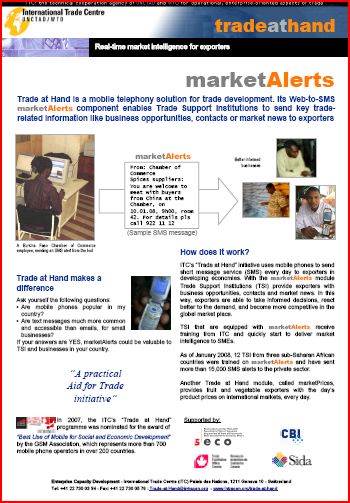
marketAlertsThis deployment option is great for large scale applications. In the area of dissemination and collection of mobile market information, I am aware of ITC’s Trade at Hand using similar deployment paths for the delivery of Market Alerts from trade support institutions to networks of exporters, and for the collection and analysis of local market information under the mCollect project.

ccpmp1The second deployment option mentioned by Mr. Jonathan Jackson includes 1) local server connected to a phone, being able to talk to local clients and 2) client machines hitting the local server directly, or through the Internet. Small deployments are viable under this option. But deployments are subject to the hazards of thier small scale. Even small problems with the systems can become critical because they require specialised engineering skills. Such deployments are at risk of losing users’ interest when qualified support is not available on the ground. A market oriented project which might fall under this category is the Cambodia Crop Production and Marketing Project (CCPMP).

Vodpod videos no longer available.

The Rapid Android technology presented my Mr. Jonathan Jackson allows for the use of Android phones not only as SMS clients, but also as back-end servers. This dual use greatly simplifies the equipment needs and the skill needs for the deployment of SMS solutions. It also allows for immediate analysis of incoming data in real time.

For the sector of mobile market information systems, Rapid Android presents enhanced SMS broadcasting and data collection opportunities. With the future developments of Rapid Android outlined by Mr. Jonathan Jackson under wasy, Rapid Android presents the opportunity to develop more resilient and extensive market infromation collection networks. Even though the benefits of broadcasting up-to-date market informatiton to farmers in remote areas have been widely recognised. I think more efforts are needed to improve the market information generation process and to ensure the quality of the information. So far the accuracy of the collected information is largely due to the skills and experience of market ennumerators based out in the field. The transformation, analysis and response to this information is tends to be removed at central head offices and headquarters. With the availability of technologies similar to Rapid Android, the opportunity of relocating the analysis closer to the source of the data opens up.

Talking about Movirtu’s MXShare

On Friday, 23 May Mr. Guy Collender  published through the Guardian, Society an opinion piece considering how mobile technology is benefiting some of the world’s poorest. Left at that, this is not a rare piece of writing to come by these days. But what made the story “Talking about a revolution” conspicuous for me was the fact that it featured Movirtu‘s MXShare — a fascinating technology I came across recently at the Africa Gathering in London.

Katine farmer Dan Ekongu with his mobile phone, which he uses to communicate about agriculture via Talking about a revolution. Photograph: Dan Chung.

I completely agree with Mr. Collender that, “At first glance it is a peculiar and nonsensical idea: owning a mobile phone number, but not a mobile phone.” And even though the immediate benefits of the idea are that it could enable the bottom billion (i.e. the 1 billion people living on less than $2 a day) “to enjoy the benefits associated with a mobile phone number, such as receiving messages and remittances,” I think it could have much wider and far-reaching consequences.

The MXShare concept, installed in the core of a mobile network, enables individuals to share a mobile phone while maintaining separate identities, including a phone number, list of contacts, etc. MXShare makes this possible by creating a virtual mobile system, embedded within an operator’s switching centre.

MXShare’s obvious caveat is that it is not operator agnostic. Many people working in development would consider this an insurmountable drawback, particularly because mobile phone information systems tend to be implemented on a fairly small scale, by NGOs and development organisation, who find it a challenge to get the interest and collaboration of large (read popular) GSM operators.

Although I can see MXShare’s operator dependance as a hindrance to its adoption, I personally am much more intrigued by the possibilities and challenges which the technology concept opens up.

The possibilities stem from the prospect of attaching a fixed identity to mobile phone users. Identifying people is still a challenge in the online world of the Internet but increasingly users of various online services are identified only by their email address and a password. Movitu’s MXShare opens the door to similar solutions to the identification problem in the world of mobiles, a world which is currently hyping about mobile-Web integrated services. Besides allowing people who live on less than $2 a day to receive remittances, the technology can be used as a gateway for the introduction of mobile-Web enabled devices in the developing world. And needless to say, alongside the better devices will come the better services — better m-health, better m-learning, and last but not least, better m-commerce.

For mobile market information services, particularly ones relying on user-generated content, the possibilities offered by identification are considerable. The ability to trace back to its author content of the “classified ad” style, submitted to user-generated content services will increase their appeal. Moreover, it could lead to improvements in the legal framework which would give legitimacy to agreements reached via mobile phone.