Buying and Selling on Mobile Phone: Market Women and Farmers Connect for Less

A story found at the Liberianmasthead. Written by Oona Burke, guest columnist; published on 19 June, 2009.

The Ministry of Commerce and Industry in collaboration with Geneva based NGO, International Trade Center has recently completed the test phase of “Trade At Hand”, a cell phone based system that helps connect market women to more competitive prices for the goods they buy. The cell phone based system works similarly to posting goods for sale in a newspaper advertisement or online (Craigslist, etc). Farmers around Liberia are able to advertise their goods for sale (for example, pepper) and market women on the system are then able to check their phones for all the advertisements of pepper for sale from farmers around the country that day. On the system, market women have access to offers organized by products, and are able to exchange reciprocal offers and match each other’s demands for the sale and purchase of goods.

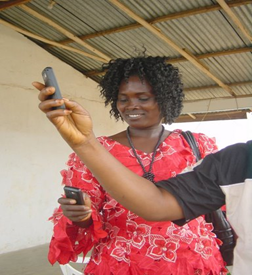
A market woman and farmer work on Trade at Hand

Thus far the test group includes the training of 50 market women across several Monrovia based markets, and 50 farmers in various counties.  Market women on the project are extremely excited about the system and are anxious to expand the number of products available to buy.

Currently the system includes pepper, okra, bitter ball, cassava, plantain, greens, palm oil /nut, and several others. With some market women on the system reporting that they usually spend as much as $35 a month on scratch cards to communicate with sellers of goods, Trade at Hand, allows market women to also reduce their communication costs by viewing a larger number of offers on their telephones, for a price lower than the cost of one telephone call.

Two market women show their excitement in practicing using the system at Ma Kebbeh compound,  Red Light Market
Two market women show their excitement in practicing using the system at Ma Kebbeh compound, Red Light Market

Trade at Hand enables market women to carry out their business in a way that increases their chances of accessing better quality and better priced produce.  In turn, farmers are also enabled to better off-load their produce, and minimize produce wastage. The system also helps market women develop their price intelligence, because they have access to a variety of prices for the same products.

Once the system is tested with the pilot group of market women and farmers, it is hoped that the system can be made available to a larger number of market women and farmers.

Trade at Hand is similar to Cell Bazaar, a telephone based buying and selling system in Bangladesh, that currently has 20 million users.

Nokia Life Tools launched across India

Here are the latest developments regarding Reuters Market Light and Nokia Life Tools. According to the press release below Nokia Life Tools is being launched across India.

June 12, 2009

Ecosystem involving key government bodies, operators & industry players to address consumers’ information gaps.

Mumbai, India – After a successful pilot in the state of Maharashtra, Nokia today announced the commercial launch of its pioneering Nokia Life Tools service in India. The service will be rolled out first in Maharashtra in association with the Maharashtra State Agricultural Marketing Board (MSAMB). Designed specifically for the emerging markets, Nokia Life Tools is a range of Agriculture, Education and Entertainment services sharply addressing the information gaps of target consumers.

Today, Nokia signed a Memorandum of Understanding (MOU) with the MSAMB. Under this MOU, MSAMB will provide expertise in the areas of commodity prices from their network of 291 local mandis (marketyards). MSAMB will also have the opportunity to deliver relevant news, alerts on schemes and other information directly to grassroots consumers.
Speaking at the occasion, Shri. Ashok Chavan, Hon’ble Chief Minister of Maharashtra said, “We are happy that Maharashtra is the first state in India to go live with the Nokia Life Tools services in association with the state marketing board. Empowering our people with the right tools and facilities is a top priority for the State Government. I would like to congratulate Nokia for developing a unique and innovative service that has tremendous potential to improve lives and the livelihood of farmers and sub-urban consumers in Maharashtra.”
Shri Harshavardhan Patil, Hon’ble Minister for Co-operation, Marketing, Cultural Affairs and Parliamentary Affairs said, “It has been the Maharashtra state government’s endeavour to provide vital agri information tools for a progressive and an empowered farmer community. Nokia Life Tools is tailormade to positively impact farmers across the state. This MOU further strengthens MSAMB’s mandate to get the information directly to the farmers.”
Mr. D Shivakumar, Managing Director, Nokia India said, “Nokia Life Tools was a result of the entire ecosystem coming together and is ideally placed to usher in an information revolution impacting the daily lives of people. We extend our sincere thanks to MSAMB and our key partners for believing in and supporting our vision of ’empowering people and connecting them to the things that matter’. We believe this is the beginning of a historical journey that will take mobility to grassroots and make a positive difference to the lives of people in the areas that are crucial to them.”
The complete Nokia Life Tools solution will be available on the newly launched Nokia 2323 classic and Nokia 2330 classic devices, and will be later expanded to other Nokia devices.
Nokia Life Tools Partner Ecosystem and Services
Designed with deep insights gathered from target users, Nokia has collaborated with multiple partners across the Indian Government and private enterprises to bring together a rich ecosystem to deliver localised & personalised information directly to consumers’ Life Tools-enabled mobile devices.
Nokia Life Tools has a range of 3 primary services – Agriculture Services, Education Services and Entertainment Services
Nokia Life Tools Agriculture services:
The Nokia Life Tools Agriculture service offers consumers a choice of 2 plans. The basic plan, available across India at Rs 30/month, provides daily weather updates and relevant agriculture-related news, advice and tips. The premium plan, at Rs 60/month, will be available in 10 states, including Maharashtra, and provides the closest market prices for three crops chosen by the subscriber, as well as weather, news, advice and tips.
Nokia is collaborating with Reuters Market Light (RML), which was the exclusive provider for agriculture services in the successful pilot. Syngenta, Madison Research, Skymet and many others also form this ecosystem.
Nokia Life Tools Education services:
The Nokia Life Tools Education service, available throughout India, offers three components: Learn English, with basic, intermediate and advanced levels; Exam preparation, which offers students tips and advice for ICSE, CBSE and State Board-level exams mapped to the relevant curriculum; and General Knowledge, which gives subscribers useful information about the world around them. Each of the Education services will be offered at Rs 30/month. Information and content from multiple local and international companies will be aggregated and delivered to Nokia Life Tools by EnableM.
Nokia Life Tools Entertainment services:
The Nokia Life Tools Entertainment service at launch will include Astrology, News, Jokes, Cricket and ringtones, offered at existing market prices. The content is aggregated and brought to Life Tools by OnMobile.
Nokia Life Tools is hosted by OnMobile in India.
Jawahar Kanjilal, Nokia’s Global Head of Emerging Markets Services, said, “As mobile coverage increases to cover the millions of unconnected, Nokia – in India and in other emerging markets around the world – will work together with mobile operators, multiple government and private enterprises, and non-government organizations to empower millions by connecting them to better opportunities that have a positive impact on their daily lives.”
Nokia Life Tools was piloted in Maharashtra earlier this year before its commercial roll-out this month. The feedback from actual subscribers during the pilot that was concluded in April 2009 revealed that the service had a wide appeal, and connected with subscribers at both emotional and rational levels. On one hand, the service brought livelihood gains through relevant information such as market rates for farmers’ produce, greater awareness on market conditions, tips on weather, news, crop advisory, Learn English and General Knowledge. On the other hand, it enabled consumers to fill their information gaps by being better informed, save time and money, and improve their confidence and social standing.
Nokia Life Tools service will be expanded to select countries across Asia and Africa later in 2009 and beyond.
About Nokia Life Tools
Nokia Life Tools is a range of innovative Agriculture information and Education services targeted at non-urban consumers. Under the Nokia Life Tool Services, consumers can choose various types of services/information that they wish to receive. Services available are as follows.
– Nokia Life Tools Agriculture services aim to plug the information gaps and needs of farmers via their mobile devices, by providing information on seeds, fertilizers and pesticides, market prices, and weather (temperature, rainfall, wind conditions)
– Nokia Life Tools Education services aim to provide education and career services, including English language learning, General Knowledge, Exam preparations and results, and career information and tips
– Nokia Life Tools Entertainment services also has fun features for subscribers, including Astrology, News on current affairs, sports, politics and other matters, Jokes and downloadable ringtones
Nokia Life Tools services use an icon-based, graphically rich user interface that comes complete with tables and which can even display information simultaneously in two languages. Behind this rich interface, SMS is used to deliver the critical information to ensure that this service works wherever a mobile phone works, without the hassles of additional settings or the need for GPRS coverage.


via Nokia – ShowPressRelease.

Rapid Android for Collecting Market Information?

I came across an interview, prepared by Ms. Katrine Veclas from MobileActive, with Mr. Jonathan Jackson of Dimagi. The interview introduces the Rapid Android technology which offers an innovative way of configuring the back-end of SMS deployments.

Mr. Jonathan Jackson, summarises the currently available deployment options as including deployments via international SMS gateways and localised deployments. Under the first option the deployment path consists of: 1) clients sending SMS to an international phone number 2) messages are transferred to an international SMS gateway 3) message go through the Internet to a Web server 4) client machines are able to access the Web server through the Internet to view the data.

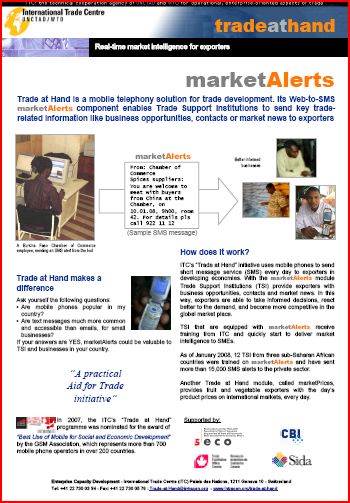
marketAlertsThis deployment option is great for large scale applications. In the area of dissemination and collection of mobile market information, I am aware of ITC’s Trade at Hand using similar deployment paths for the delivery of Market Alerts from trade support institutions to networks of exporters, and for the collection and analysis of local market information under the mCollect project.

ccpmp1The second deployment option mentioned by Mr. Jonathan Jackson includes 1) local server connected to a phone, being able to talk to local clients and 2) client machines hitting the local server directly, or through the Internet. Small deployments are viable under this option. But deployments are subject to the hazards of thier small scale. Even small problems with the systems can become critical because they require specialised engineering skills. Such deployments are at risk of losing users’ interest when qualified support is not available on the ground. A market oriented project which might fall under this category is the Cambodia Crop Production and Marketing Project (CCPMP).

Vodpod videos no longer available.

The Rapid Android technology presented my Mr. Jonathan Jackson allows for the use of Android phones not only as SMS clients, but also as back-end servers. This dual use greatly simplifies the equipment needs and the skill needs for the deployment of SMS solutions. It also allows for immediate analysis of incoming data in real time.

For the sector of mobile market information systems, Rapid Android presents enhanced SMS broadcasting and data collection opportunities. With the future developments of Rapid Android outlined by Mr. Jonathan Jackson under wasy, Rapid Android presents the opportunity to develop more resilient and extensive market infromation collection networks. Even though the benefits of broadcasting up-to-date market informatiton to farmers in remote areas have been widely recognised. I think more efforts are needed to improve the market information generation process and to ensure the quality of the information. So far the accuracy of the collected information is largely due to the skills and experience of market ennumerators based out in the field. The transformation, analysis and response to this information is tends to be removed at central head offices and headquarters. With the availability of technologies similar to Rapid Android, the opportunity of relocating the analysis closer to the source of the data opens up.

Mobile Money

Vodpod videos no longer available.

Continuing the theme of alternative payment systems, and particularly the recent posts and discussions of the M-Pesa success story in Kenya, here is an interview panel on the topic, provided by TelecomTV’s programme Main Agenda.

The discussion took place during 16-19 Feb at the Mobile World Congress in Barcelona. The panel features Mr. Gavin Krugel, Director Mobile Money, GSMA Association who articulates the major commitment of mobile network operator groups such as Orange, MTN and Vodafone behind financial service offerings. Network operators value the added value of such services alongside their standard offerings of SMS, voice and data.

He illustrates the scale of the opportunity offered to network operators in mobile money with the fact that 1 billion consumers in developing markets who do not have a bank account but do have a mobile phone. As a further illustration, a leading financial institution in India has 10 000 branches, while a leading network operator in India has 1 million distribution points. Through their network brands, innovation and secure technologies, mobile network operators are uniquely positioned to meet the opportunity and respond to the need for entry level financial services.

Mr. Vitalis Olunga, Head of International Services, Safaricom presents the opportunity of extending the M-Pesa mobile money concept of Safaricom, Kenya to include cross-border roaming services. He addresses the issue of regulation which came up in my posts from last week. Mr. Olunga tells how when M-Pesa was started in Kenya there was no regulation and the policy was developing post-factum. He sees a considerable challenge for the regulators in distinguishing between telecommunication and financial services. Additionally, mobile money increases the levels of competition in two highly regulated sectors in developing countries: the telecommunications and the financial sectors.

Mr. Hans Paulsen, CCO, Uganda Telecom shares his views regarding mobile financial services. He presents the opportnity present in Uganda to increase the current number of bank customers from 200 000 to 8 000 000 mobile phone users. The main application area Mr. Paulsen considers is that of remittences between urban and rural areas. With regards to regulation he stresses that success stories such as M-Pesa raise questions for telecom regulators and the banking sector regulators.

Mr. Patrick Kariningufu, Rwandatel emphasises that M-Pesa “was a great idea 4 years ago” and currently Rwandatel are looking for ways to enable people in the diaspora to transfer payments to African countries. Mr. Luckas Scoczkowski, CEO, Redknee presents their portfolio including re-sell airtime, emergency airtime, international remittances, and crossborder money transfers.

Mobile Money by M-Pesa: a need or a luxury?

In a recent post I noted the news about Safaricom’s profitability in the last year and exchanged some thoughts about the services, fair pricing and values provided by African mobile operators with Steve Song.

Eariler this week I came across the Round. The world. Connected. project of the Nokia Siemens Networks. In its Episode 2 finds Adrian Simpson visits Ethiopia and Kenya. Among the bonus features are an interview with Mr. Michael Joseph, CEO of Safaricom, interviews with users and providers of the M-Pesa service.

Mr. Michael Joseph introduces the needs and benefits of the M-Pesa service, emphasizing its value outside the main urban areas where banking infrastructure is rarely available. He recounts the origins of the M-Pesa service in 2006 within a microfinancing project and explains its current popularity. By saving users the hazards of carrying and transacting in cash M-Pesa allows its users greater degree of mobility and flexibility. Mr. Michael Joseph stresses that M-Pesa is a banking product. This complicates the service by imposing strict security requirements on the technology, five-year record keeping requirement, and customer rules.

Mr. Michael Joseph emphasises the importance of the distribution and support network for the M-Pesa service. He acknowledges that Safaricom’s ARPU is decreasing and explains Safaricom’s strategy to “lock-in” customers through the provision of a mobile banking service which can be perceived as a daily necessity. Furthermore, Safaricom counts 7500 franchises of M-Pesa stores where users of the service can receive personalised support and loyalty to Safaricom can develop as a result of the social capital exchanged in between the users and the representatives of the distribution network. Adrian Simpson gives faces to the M-Pesa distribution/ support network by interviewing an M-Pesa store owners.

In the video “The benefits of M-Pesa and mobile banking in Africa” Adrian Simpson shows documents used in the registration for use of the service and talks to an M-Pesa dealer who claims thousands of customers visiting his shop. The location seems fairly central and the customers appear “upmarket”. He mentions businesses and university students as his customers.

In “Interview with an M Pesa store owner in Africa” Adrian Simpson talks to Joseph, an M-Pesa agent working in somewhat more moderate surroundings. He emphasises customer service, technology assistance and personal attention as important considerations for keeping his customer base.

Towards the end of the interview with Mr. Michael Joseph the subject of regulation is brought up. Not surprisingly, Mr. Michael Josephs mentions that mobile operators in Africa are seen as “cash cows” and a reduced tax burden would help help their work. Still, I wonder how regulation can be used in order to provide mobile operators with the incentive to support, invest in and develop socially benefitial services. M-Pesa seems to facilitate the monetary transactions of socially excluded people and it appears to alleviate concerns related to security. As such, the service has required considerable investment in technology development and the set-up of a distribution network. With considerable set-up costs, the service has broken even only recently after subscribing 6 000 000 users in December 2008. Admittedly, Safaricom has invested in it with strategic self-interest, looking towards customer loyalty and “lock-in” opportunities. Still, I wonder how governments cound encourage mobile operators to behave in a similar way, rather than to follow more disruptive strategies. If we view mobile services like M-Pesa as social goods, rather than luxuries, how can regulation be used to have more of them?

Talking about Movirtu’s MXShare

On Friday, 23 May Mr. Guy Collender  published through the Guardian, Society an opinion piece considering how mobile technology is benefiting some of the world’s poorest. Left at that, this is not a rare piece of writing to come by these days. But what made the story “Talking about a revolution” conspicuous for me was the fact that it featured Movirtu‘s MXShare — a fascinating technology I came across recently at the Africa Gathering in London.

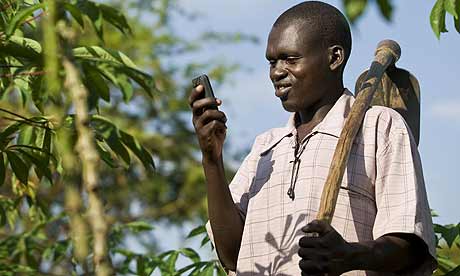
Katine farmer Dan Ekongu with his mobile phone, which he uses to communicate about agriculture via Talking about a revolution. Photograph: Dan Chung.

I completely agree with Mr. Collender that, “At first glance it is a peculiar and nonsensical idea: owning a mobile phone number, but not a mobile phone.” And even though the immediate benefits of the idea are that it could enable the bottom billion (i.e. the 1 billion people living on less than $2 a day) “to enjoy the benefits associated with a mobile phone number, such as receiving messages and remittances,” I think it could have much wider and far-reaching consequences.

The MXShare concept, installed in the core of a mobile network, enables individuals to share a mobile phone while maintaining separate identities, including a phone number, list of contacts, etc. MXShare makes this possible by creating a virtual mobile system, embedded within an operator’s switching centre.

MXShare’s obvious caveat is that it is not operator agnostic. Many people working in development would consider this an insurmountable drawback, particularly because mobile phone information systems tend to be implemented on a fairly small scale, by NGOs and development organisation, who find it a challenge to get the interest and collaboration of large (read popular) GSM operators.

Although I can see MXShare’s operator dependance as a hindrance to its adoption, I personally am much more intrigued by the possibilities and challenges which the technology concept opens up.

The possibilities stem from the prospect of attaching a fixed identity to mobile phone users. Identifying people is still a challenge in the online world of the Internet but increasingly users of various online services are identified only by their email address and a password. Movitu’s MXShare opens the door to similar solutions to the identification problem in the world of mobiles, a world which is currently hyping about mobile-Web integrated services. Besides allowing people who live on less than $2 a day to receive remittances, the technology can be used as a gateway for the introduction of mobile-Web enabled devices in the developing world. And needless to say, alongside the better devices will come the better services — better m-health, better m-learning, and last but not least, better m-commerce.

For mobile market information services, particularly ones relying on user-generated content, the possibilities offered by identification are considerable. The ability to trace back to its author content of the “classified ad” style, submitted to user-generated content services will increase their appeal. Moreover, it could lead to improvements in the legal framework which would give legitimacy to agreements reached via mobile phone.

Kenya’s Safaricom takes a pasting. Has economic contagion finally reached the booming markets of Africa?

Below I am reprinting a news report by Martyn Warwick , published at TelecomTV | News on 22 May 2009. The report covers thereduction of profits by 23%, announced by Kenya’s and Africa’s biggest mobile operator Safaricom. Alongside with the reduction in profits, the story mentions the significant annual growth in the number of registered users for Safaricom’s M-Pesa mobile money transfer service. The number of registered users for M-Pesa increased from 2.1 million to 6.1 million. Both of these news from Safaricom in Kenya indicate the relevance and timeliness of the revenue opportunities offered to African mobile operators by mobile market services.

safaricomlogoMore evidence today that the recession is a truly global phenomenon. While in the developed economies of North America, Europe, Japan and Australasia ARPU has been falling and sales of handsets are in decline, over in the burgeoning markets of Africa, (Egypt, Nigeria, South Africa and Kenya, for example) the mobile industry has continued to roar ahead -until today. Martyn Warwick reports.

But today comes news that, for one carrier at least, the economic downturn has now hit home and profitability is on the wane at Safaricom of Kenya, Africa’s biggest mobile carrier.

Mobile penetration in Africa has roared ahead in recent ayears and some industry observers had opined that companies like Safaricom might continue to grow despite the recession. It seems now that this has more to do with wishful thinking than dispassionate analysis.

Figures released this morning show that Safaricom’s full-year profits slid by 23 per cent – mainly because of the prevailing economic conditions but increased competition and increased costs of servicing debt have also played their part.

For the financial year ended 31 March Safaricom made a profit of 15.3 billion Kenyan Shillings – that’s about £126 million Sterling. For the previous year ended march 31, 2008, the company made 19.9 billion Shillings in profit.

Perhaps more worrying is that although the operator’s total revenues were up 15 per cent year on year, ARPU (globally accepted as being a major indicator of performance) is in serious decline have fallen by a massive 23 per cent to 475 Shillings a month.

Over the past 12 months Kenya has suffered remarkably high inflation as the national currency has weakened and the costs of basic foodstuffs, fuel and transport have rocketed. Kenyan consumers, the vast majority of whom are far from wealthy, have less disposable discretionary income than they did 12 months ago and they are using their phones less.

Confidence was also severely dented by the ethnic violence that followed the results of the disputed 2008 general election and that has had a long-term effect on the economy.

Safaricom has been one of Africa’s great success stories. It is the biggest company in East Africa, is valued at in excess of £1 billion, has 2,300 employees and 13 million subscribers. The company is 40 per cent owned by Vodafone, 25 per cent by both private and institutional investors and 35 per cent owned by the Kenyan state.

It has a market share of 79 per cent and has increased its customer base by 31 per cent over the course of 18 months.

However, the market is changing and Safaricom faces increased competition from a raft of rivals including Essar telecom’s “Yu”, Zain of Kuwait and the Orange network of the incumbent, Telkom Kenya. As a result of this intense competition mobile tariffs have fallen by 40 per cent in just a year.

mpesaCommenting on the results, Safaricom’s CEO, the amiable and approachable Michael Joseph said, “It was probably our most challenging year in terms of operating environment. But it’s not all gloom, we have delivered strong results despite the difficult economic conditions and there has been strong growth in the popular M-Pesa money transfer services, with 6.2 million registered users now compared to the 2.1 million of the previous year.”

The CEO added that Safaricom will continue to invest in its network and will also look to acquisitions to maintain its strategy for consistent growth. Mr. Joseph said, “Our capital expenditure is expected to remain high over the next few years as we continue the roll out of our data infrastructure and continue to invest in the capacity, coverage and quality of our network.”

Meanwhile, Richard Hurst, a senior telecoms analyst at research house IDC commented, “In the past, Safaricom has been quite a solid operator, usually coming up with some decent numbers, so it is a bit of a surprise,” and added that Safaricom will have to spend big money on enhancing and expanding its infrastructure if it is to fend off competition and maintain its Number One position.

Hurst believes though that the overall African telecoms will continue to grow at rates higher than in other markets. He says, “We’ve still got some quite substantial growth to go, it’s [the African market] not as saturated as the European, North American or even Asian markets. I think this is just a blip.”

Let’s hope so. New figures from Nigeria expected to be published in the coming weeks may show whether this is indeed a “blip” confined to one company in one country or if the malaise is spreading across Africa.

Market Information System for Ethiopia

News regarding current work on the implementation of a market information systems in Ethiopia, released by Wageningen University and Research Centre (Wagenigen UR – LEI) on 24 Feb 2009.

From 24 to 31 January, Olga van der Valk and Monika Sopov (Wageningen International) visited Ziway and Meki, two villages in the Rift Valley south of Addis Ababa, Ethiopia. Their goal was to develop a Market Information System (MIS) for small-scale outgrowers of green beans, whose production is contracted by an exporter to Europe. The design of an MIS was requested by a project with CFC funding aiming at promoting small-scale growers’ participation in exports. In a workshop with local stakeholders, the findings of an earlier assessment on market information sources and communication lines were discussed.

An MIS is an instrument to reduce market insecurity by providing more transparency in the market. Other instruments are the implementation of (innovative) technology and horizontal and vertical market coordination to strengthen market position and to combat seasonality. To further define the MIS, stakeholders were asked to prioritise their demand for information: whether related to export or domestic markets; whether on daily-changing information such as prices and supply or on market-technical data for the development of marketing strategies.

Neither stakeholders nor farmers currently work with or have a view on long-term marketing strategies to develop the small-scale horticulture sector. This makes it difficult to prioritise the marketing information needed to design and operate an MIS. The proposal by the workshop stakeholders was to enter into dialogue with the Ethiopian government to improve its centralised MIS used for statistical purposes, and to make it more accessible to farmers. The recommendation by the Dutch experts was to set up a business service centre to collect available historical data, including surveys and statistical information, and use this information in the development of marketing planning skills among small-scale farmers and governmental officers. This will enable farmers to efficiently use and sustain the technology currently in development.

Mobile Use Behaviour in Liberia

During my work with ITC on Liberia, I was in touch with field contacts and I had the opportunity to discuss the state of the mobile telephony sector there, the available services and their prices. One of my reliable contacts there shared with me the following information. She said, that the average amount spent on pre-paid mobile phone cards (aka scratch cards) in Liberia is $5 per month. Apparently, most of the $5 of airtime credit  is used up within a few days of scratching the card. How could we possibly account for such behaviour? I’ve been thinking up hypotheses about it:

  1. One obvious suggestion would be that people go into the trouble and expense of getting the scratch card because they have some particular significant information need, or emergency which requires conversations at considerable length. Then the question becomes, how is it that these events re-occcur with considerable regularity, approximately every month?
  2. A variant of the same scenario would be the use of the airtime for a short but expensive conversation. For example, parents in Liberia calling their children overseas.
  3. A completely differnet way of looking at it, would relate to the nature of the social networks people are part of. Say, for example, if someone has enough money to buy credit then he/she is expected to get in touch with many people in order to re-affirm their identity as part of a group.
  4. Yet another scenario would be that once someone had airtime credit on their phone, the airtime credit is considered communal. So the people in their immediate surrounding feel entitled to use the phone.

What do you think? Any suggestions on the matter?

Collaboration@Rural in South Africa

Collaboration and Rural (C@R) is an EU project aimed at enabling the participation of European rural dwellers in the knowledge society. The methodology of the project involves the testing new technologies developed by the C@R consotium within 7 Living Labs, including the Sekhukhune Living Lab in South Africa.

Below is a video material presenting the technology developed by SAP to the benefit of SMEs and micro enterprises, within the C@R project. The featured procurement technology is focused on realising benefits through the aggregation of rural demand for manufactured goods andprocessed foodstuffs. The savings are realised due to the lower prices, achieved by a coallition of buyers who manage to order together greater quantities via mobile communication.

The main beneficiaries of the system are Spaza shops which are scattered all over the area and ensure the supply to the rural community of bread and other items such as soap, detergent, clothes etc. Stock replendishment is a challenge to Spaza shop owners because goods need to be sourced from the nearest town, which involves a transportation cost and the opportunity cost of day’s work. Ms. Sesina Mabuza, a Spaza shop owner recounts the financial constraints she faces in re-stocking her shop. Ms. Christina Zikhali, a Spaza shop owner in a very remote village explains the variability of the transportation costs incurred by using shared taxi services.

Vodpod videos no longer available.

Consistent with New Institutional Economics, C@R seeks to reduce transaction costs through vertical integration. The system implemented by SAP facilitates the establishment of virtual buying cooperatives, consisting of a number of Spaza shops and coordinated by local information service providers, known as “nfopreneurs”. The video presents the example of bread supply. Retail shop owners are enabled to order the bread they need via SMS. The messages retailers send to the “infopreneurs” consist of the name of their shop, a PIN number verifying their identity, the amount they are ordering and the code of the product. The SMS messages are aggregated by the “infopreneurs”, they are bundled and transmitted to the suppliers of the product. The system is of benefit to the suppliers by allowing them higher visibility of the market for their product. Mr. Hansie du Plessis, Manager of Tubatse Bakery in Sasko testifies to the benefit to suppliers. The savings realised are used for the delivery of the products to the Spaza shops.

The video suggests that in the future the entire basket of items carried by Spaza shops might be available through the C@R procurement system implemented by SAP in the Sekhukhune Living Lab. I think that this is a truely exciting prospect.

Mobile Market Design for Development

Design a site like this with WordPress.com
Get started