Dec 30th 2009
From The Economist print edition
How you use your mobile phone has long reflected where you live. But the spirit of the machines may be wiping away cultural differences
Illustration by James Fryer

TECHNOLOGIES tend to be global, both by nature and by name. Say “television”, “computer” or “internet” anywhere and chances are you will be understood. But hand-held phones? For this ubiquitous technology, mankind suffers from a Tower of Babel syndrome. Under millions of Christmas trees North and South Americans have been unwrapping cell phones or celulares. Yet to Britons and Spaniards they are mobiles or móviles. Germans and Finns refer to them as Handys and kännykät, respectively, because they fit in your hand. The Chinese, too, make calls on a sho ji, or “hand machine”. And in Japan the term of art is keitai, which roughly means “something you can carry with you”.
This disjunction is revealing for an object that, in the space of a
decade, has become as essential to human functioning as a pair of
shoes. Mobile phones do not share a single global moniker because the origins of their names are deeply cultural. “Cellular” refers to how modern wireless networks are built, pointing to a technological
worldview in America. “Mobile” emphasises that the device is
untethered, which fits the roaming, once-imperial British style. HANDY highlights the importance of functionality, much appreciated in Germany. But are such differences more than cosmetic? And will they persist or give way to a global mobile culture?
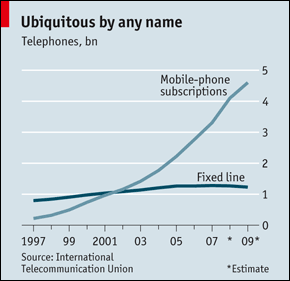
Such questions bear asking. It is easy to forget how rapidly mobile
phones have taken over. A decade ago, there were fewer than 500m mobile subscriptions, according to the International Telecommunication Union (ITU). Now there are about 4.6 billion (see chart). Penetration rates have risen steeply everywhere. In rich countries subscriptions outnumber the population. Even in poor countries more than half the inhabitants have gone mobile. Dial a number and the odds are three to one that it will cause a mobile phone, rather than a fixed-line one, to ring somewhere on the planet.
As airtime gets cheaper, the untethered masses tend to use their
mobiles more. In early 2000 an average user spoke for 174 minutes a month, according to the GSM Association (GSMA), an industry group. By early 2009 that had risen to 261 minutes, which suggests that humanity spends over 1 trillion minutes a month on mobiles, or nearly 2m years. Nobody can keep track of the flood of text messages. One estimate suggests that American subscribers alone sent over 1 trillion texts in 2008, almost treble the number sent the previous year.
Now a further mobile-phone revolution is under way, driven by the
iPhone and other “smart” handsets which let users gain access to the
internet and download mobile applications, including games,
social-networking programs, productivity tools and much else besides. Smart-phones accounted for over 13% of the 309m handsets shipped in the third quarter of 2009. Some analysts estimate that by 2015 almost all shipped handsets will be smart. Mobile operators have started building networks which will allow for faster connection speeds for an even wider variety of applications and services.
ALL ALIKE, ALL DIFFERENT
Yet these global trends hide starkly different national and regional
stories. Vittorio Colao, the boss of Vodafone, which operates or
partially owns networks in 31 countries, argues that the farther south you go, the more people use their phones, even past the equator: where life is less organised people need a tool, for example to rejig appointments. “Culture influences the lifestyle, and the lifestyle influences the way we communicate,” he says. “If you don’t leave your phone on in a meeting in Italy, you are likely to miss the next one.”
Other mundane factors also affect how phones are used. For instance, in countries where many people have holiday homes they are more likely to give out a mobile number, which then becomes the default where they can be reached, thus undermining the use of fixed-line phones. Technologies are always “both constructive and constructed by historical, social, and cultural contexts,” writes Mizuko Ito, an anthropologist at the University of California in Irvine, who has co-edited a book on Japan’s mobile-phone subculture.
Indeed, Japan is good example of how such subcultures come about. In the 1990s Americans and Scandinavians were early adopters of mobile phones. But in the next decade Japan was widely seen as the model for the mobile future, given its early embrace of the mobile internet. For some time WIRED, a magazine for technology lovers, ran a column called “Japanese schoolgirl watch”, serving readers with a stream of KEITAI oddities. The implication was that what Japanese schoolgirls did one day, everyone else would do the next.
The country’s mobile boom was arguably encouraged by underlying social conditions. Most teenagers had long used pagers to keep in touch. In 1999 NTT, Japan’s dominant operator, launched i-mode, a platform for mobile-internet services. It allowed cheap e-mails between networks and the Japanese promptly signed up in droves for mobile internet. Ms Ito also points out that Japan is a crowded place with lots of rules. Harried teenagers, in particular, have few chances for private conversations and talking on the phone in public is frowned upon, if not outlawed. Hence the appeal of mobile data services.
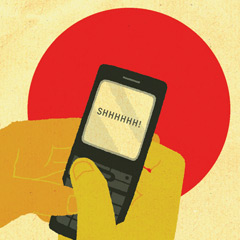
The best way to grasp Japan’s mobile culture is to take a crowded
commuter train. There are plenty of signs advising you not to use your phone. Every few minutes announcements are made to the same effect. If you do take a call, you risk more than disapproving gazes. Passengers may appeal to a guard who will quietly but firmly explain: “DAME DESU”–it’s not allowed. Some studies suggest that talking on a mobile phone on a train is seen as worse than in a theatre. Instead, hushed passengers type away on their handsets or read mobile-phone novels (written Japanese allows more information to be displayed on a small screen than languages that use the Roman alphabet).
Might the Japanese stop talking entirely on their mobiles? They seem less and less keen on the phone’s original purpose. In 2002 the average Japanese mobile user spoke on it for 181 minutes each month, about the global norm. By early 2009 that had fallen to 133 minutes, then only half the world average. Nobody knows how many e-mails are sent, but the Japanese are probably even more prolific than text-crazy Indonesians, who average more than 1,000 messages per month on some operators. No wonder that Tokyo’s teenagers have been called the “thumb generation”.
HANDY IF YOU’RE THRIFTY
Others are quiet, too. On average Germans–who are fond of saying that “talk is silver, silence is golden”–spend only 89 minutes each month calling others for HANDY-based conversation. This may be a result of national telephone companies on both sides of the Berlin Wall having exhorted subscribers for years to “keep it short” because of underinvestment in the East and rapid economic growth that overtaxed the network in the West. Germans are also thrifty, suggests Anastassia Lauterbach of Deutsche Telekom. For longer calls, she says, consumers resort to much cheaper landlines.
In contrast, Americans won’t shut up. Their average monthly talk-time is a whopping 788 minutes, though some of this is a statistical illusion because subscribers also pay for incoming calls. Yet talk is cheap: there is no roaming charge within the United States. Americans are often in their cars, an ideal spot for phone calls, especially in the many states where driving and talking without headsets is still legal.
The chattiest of all are Puerto Ricans, who have by far the highest
monthly average in the world of 1,875 minutes, probably because
operators on the American island offer all-you-can-talk plans for only $40, which include calls to the mainland. This allows Puerto Ricans to chat endlessly with their friends in New York, but may also have arbitrageurs routing cheap international phone calls through the island.
Just how people behave when talking on a mobile phone is a question of culture, at least at first, according to Amapro Lasen, a sociologist at Universidad Complutense in Madrid. In the early 2000s she studied phone users in the Spanish capital, in Paris and in London. Mobiles were a common sight, but Parisians and Madrileniens felt freer to talk in the street, even in the middle of the pavement. Londoners, by contrast, tended to gather in certain zones, for instance at the entrances of tube stations–the sort of place Ms Lasen calls an “improvised open-air wireless phone booth”.
In Paris people openly complained when bothered by others talking
loudly about intimate matters, but complaints were rare in London. In both places, people tended to separate phone and face-to-face
conversations, for instance by retreating to a quiet corner. But
subscribers in Madrid often mixed them and even allowed others to take part in their phone conversations. The Spanish almost always take a call and most turn off voicemail.
For Ms Lasen, who has lived in all three cities, such variations
reflect how people traditionally use urban space. In London, she says, the streets are mainly for walking, “like the bed where the river
flows”. Paris, however, is a place to stroll, the home of the FLaNEUR.
In Madrid people inhabit the streets to talk together. As for their
aversion to voicemail, the Spanish consider it rude to leave a call
unanswered, even if it is inconvenient. This may be the result of a
strong sense of social obligation towards friends and family.
Elsewhere, too, culture and history may help determine whether people talk in public or take a call. The Chinese often let themselves be interrupted, fearing that otherwise they could miss a business
opportunity. Uzbeks use their mobiles only rarely in public, because the police might be listening. And Germans can get quite aggressive if people disobey the rules, even unwritten ones. In 1999 a German man died in a fight triggered by his ill-mannered HANDY use.
Economics and other hard factors also shape habits. Olaf Swantee, the head of Orange’s mobile business, notes that pricey handsets are less popular in Belgium than in Britain because Belgian operators have long been barred from subsidising phones, a strategy widely used on the other side of the Channel. Italy, however, exhibits both low subsidies and many high-end handsets. Subscribers there do not want to spend much on airtime, but are keen to buy a flashy phone.
China is distinct because of economics and relatively lax regulation.
Many consumers use SHANZHAI (“bandit”) phones, produced by hundreds of small handset-makers based on chips and software from Mediatek, a Taiwanese firm. Knock-offs are common, with labels such as “Nckia” and “Sumsung”. Other innovative manufacturers have developed specialised phones, for instance handsets that can respond to two phone numbers, or models with giant speakers for farmers on noisy tractors.
Elsewhere the physical environment determines which kinds of handsets prevail, says Younghee Jung, a design expert at Nokia, the world’s largest maker of handsets. In hot India, for instance, men rarely wear jackets, but their shirts have pockets to hold phones–which therefore cannot be large. Indian women keep phones in colourful pouches, less as a fashion statement than as a way to protect the devices and preserve their resale value. It also makes for a noteworthy contrast with Japan, says Ms Jung. If women there keep phones in a pouch and decorate them with stickers and straps, that has nothing to do with economics, but reflects the urge to personalise the handset. Phones are highly subsidised in Japan and the resale value is essentially nil, so it is not unusual to see lost units lying in the gutter.
In some countries it is a common habit to carry around more than one phone. Japanese workers often have two: a private one and a work one (which they often turn off so bosses cannot get them at any hour). “I have one phone for work, one for family, one for pleasure and one for the car,” says a Middle Eastern salesman quoted in a study for Motorola, a handset-maker. Having several phones is often meant to signal importance. Latin American managers, for instance, like to show how well connected they are: some even have a dedicated one for the boss.
As this example suggests, softer factors may influence the choice and design of hardware, even for networks. If coverage in America tends to be patchy, it is not least because consumers seem willing to endure a lot and changing operators is a hassle. Elsewhere the reverse is true. Italians demand good reception on the ski slopes, the Greeks on their many islands and Finns in road tunnels, however remote. If coverage is poor, subscribers will switch.
Paradoxically, however, it is in Italy and Greece that people are
especially worried about the supposed health risks of electromagnetic fields. A 2007 survey commissioned by the European Commission found that 86% of Greeks and 69% of Italians were “very” or “fairly” concerned about them, compared with 51% in Britain, 35% in Germany and only 27% in Sweden. It may be that people fret when they lack reliable information–or that in some countries local politicians stir up fears.
Whatever the reasons, the public reaction explains why phone masts in Italy are often disguised, for instance as the arches of a hamburger restaurant, as a palm tree or even as the cross on a famous cathedral. In Moldova, by contrast, such masts are monuments to prosperity. “Every time we put up a mast, they had a party. It connected them,” says Orange’s Mr Swantee.
Yet digital technologies change quickly, and so do attitudes towards
them. Will such differences between cultures persist and grow larger, or will they diminish over time? Companies would like to know, because it costs more to provide different handsets and services in different parts of the world than it would do to offer the same things everywhere.
ENTER THE APPARATGEIST
A few years ago such questions provoked academic controversy. Not everybody agrees with Ms Ito’s argument that technology is always socially constructed. James Katz, a professor of communication at Rutgers University in New Jersey, argues that there is an APPARATGEIST (German for “spirit of the machine”). For personal communication technologies, he argues, people react in pretty much the same way, a few national variations notwithstanding. “Regardless of culture,” he suggests, “when people interact with personal communication technologies, they tend to standardise infrastructure and gravitate towards consistent tastes and universal features.”
Recent developments seem to support him. When Ms Lasen went back to London, Paris and Madrid a few years later, phone behaviour had, by and large, become the same in the different cities (although Spaniards still rejected voicemail). Yet it is not just the APPARATGEIST that explains this, argues Ms Lasen. In all three cities, she says, people lead increasingly complex lives and need their mobiles to manage them. Ms Ito agrees. American teenagers now also text madly, in part because their lives are becoming almost as regulated as those of the Japanese.
This convergence is likely to continue, not least because it is in the
interest of the industry’s heavyweights. Handsets increasingly come
with all kinds of sensors. Nokia’s Ms Jung, for instance, is working on
a project to develop an “Esperanto of gestures” to control such
environmentally aware devices. Her team is trying to find an
internationally acceptable gesture to quieten a ringing phone. This is tricky: giving the device the evil eye or shushing it, for instance,
will not work. Treating objects as living things might work in East
Asia, where almost everything has a soul, but not in the Middle East,
where religious tenets make this unacceptable.
In the long run most national differences will disappear, predicts
Scott Campbell of the University of Michigan, author of several papers on mobile-phone usage. But he expects some persistence of variations that go back to economics. In poorer countries subscribers will handle their mobile phones differently simply because they lack money. Nearly all airtime in Africa is pre-paid. Practices such as “beeping” are likely to continue for quite a while: when callers lack credit, they hang up after just one ring, a signal that they want to be called back.
A few differences may remain within borders, suggests Kathryn
Archibald, who works at Nokia and tries to understand consumers in different parts of the world. Only a few countries, mainly in Africa
and Asia, still need special cultural attention when designing a phone (which is why some models in India double as torches). “We see more differences within countries than between them,” she says.
Nokia breaks down phone users into various categories, rather than by geography. “Simplicity seekers” barely know how to turn on their phones and use them only in case of trouble. At the other end of the spectrum, “technology leaders” always want the latest devices and feel crippled without their phones. “Life jugglers” need their handsets to co-ordinate the many parts of their lives. Ms Archibald says Nokia’s aim is to offer the right handset to each such group.
But when it comes to content–the services offered via the phones and the applications installed on them–Nokia pays considerable attention to local culture. In India and other developing countries the firm has launched a set of services called “Life Tools”, which ranges from agricultural information for farmers to educational services such as language tuition. In many rich countries, by contrast, handsets come bundled with a subscription to download music. “We need to operate globally, but be relevant locally,” concludes Ms Archibald.
All this raises a question: as differences fade, are people becoming
slaves to the APPARATGEIST? “Because of our evolutionary heritage, we want to be in perpetual contact with others,” argues Mr Katz. Just as technology allows people to overeat, it now lets them overcommunicate. If this is a problem now, imagine what would happen if telepathy become possible. The thought is not entirely far-fetched: researchers at Intel, a chipmaker, are devising ways to use brain waves to control computers. A phone that can be implanted in your head may be just a few years away–at which point the Germans will no longer be able to call it a HANDY.
via Mobile-phone culture: The Apparatgeist calls | The Economist.

 Mobile phone ownership in low and middle-income countries has skyrocketed in the past several years. But a woman is still 21% less likely to own a mobile phone than a man. Closing this gender gap would bring the benefits of mobile phones to an additional 300 million women. By extending the benefits of mobile phone ownership to more women, a host of social and economic goals can be advanced.The Women & Mobile report is the first comprehensive view of women and mobile phones in the developing world. This report, sponsored by the GSMA Development Fund and Cherie Blair Foundation for Women, explores the commercial and social opportunity for closing the mobile gender gap. The report builds off of a survey conducted with women on three continents to show their mobile phone ownership, usage, barriers to adoption and preferences. The report shows how mobile phone ownership can improve access to educational, health, business and employment opportunities and help women lead more secure, connected and productive lives. It also includes ten case studies highlighting the strategies and tactics that both mobile network operators and non-profit organizations across the globe are implementing to increase the usage and impact of mobile phones around the world.


 When you access the education part of Life Tools there are three strands you can pursue – learning English, preparing for school and higher education exams, and improving your general knowledge.
 Nokia Life Tools will launch in Indonesia in early December 2009, and will debut on the Nokia 2323 classic, Nokia 2330 classic and Nokia 2700 classic. It’ll later become available on the five new devices announced today for Indonesia, including the Nokia 1280 (Nokia’s cheapest ever phone), Nokia 1616, Nokia 1800, Nokia 2220 slide and Nokia 2690.
 MMD4D
MMD4D 